FAST-CASUAL MEXICAN VALUE COMPARISON
Chipotle vs QDOBA: Prices, Portions, and Value Compared
Chipotle and QDOBA both build meals around customizable burritos, bowls, tacos, and add-ons, but their value works differently. QDOBA includes a first portion of guac and queso on create-your-own entrées at no extra charge, while Chipotle has a stronger points-earning rate but can charge for premium extras. Restaurant pricing varies, so the final winner depends on the location and exact order.
10 pts / $1
Chipotle Rewards earns 10 points per eligible dollar spent.
1 pt / $1
QDOBA Rewards earns 1 point per eligible dollar and converts 125 points into a free entrée.
Guac + queso
QDOBA includes the first portion on create-your-own entrées at no extra charge.
Local prices
Use the selected restaurant and ordering channel for the final checkout comparison.
Price note: Chipotle and QDOBA use restaurant-level pricing, and customization can change the total. Delivery can also introduce higher menu pricing, fees, or different promotion eligibility. Compare the same entrée, extras, and ordering channel at the locations you plan to use.
The Short Answer
QDOBA can offer better built-in value when you want guacamole and queso, while Chipotle can be the better fit if you prefer its ingredient mix, menu format, or rewards ecosystem. QDOBA explicitly includes a first portion of guac and queso on create-your-own entrées at no extra charge. Chipotle lets you build a similarly customizable meal, but premium extras such as guacamole, queso blanco, or extra protein can increase the price on many orders.
For item-level pricing, start with the Chipotle menu with prices. That page is the better place to compare burritos, bowls, tacos, salads, quesadillas, kids meals, sides, and protein choices. This comparison focuses on how those prices translate into value against QDOBA.
The QDOBA menu with prices is useful when you want to compare create-your-own entrées, signature meals, nachos, quesadillas, tacos, breakfast at participating locations, and family options. QDOBA’s included first portion of guac and queso can matter more than a small base-price difference if those are toppings you would order anyway.
You can also browse the Mexican & Tex-Mex menu category to compare both chains with Taco Bell, Del Taco, and other Mexican-inspired restaurant options. A fast-casual entrée may cost more than a value-menu item, but it can also replace several smaller items in one order.
Chipotle vs QDOBA Price and Value Comparison
Neither chain publishes one nationwide entrée price that works for every restaurant. The useful comparison is the structure of the order: base entrée, protein, premium toppings, sides, drinks, rewards, and ordering channel. If two nearby restaurants have similar base prices, included toppings can become the deciding factor.
| Value area | Chipotle | QDOBA | What it means |
|---|---|---|---|
| Base entrée pricing | Varies by restaurant and protein | Varies by restaurant and protein | Compare the selected locations |
| Guacamole | Can be an extra charge on many non-veggie orders | First portion included on create-your-own entrées | QDOBA can gain value if you want guac |
| Queso | Queso blanco can add to the total | First portion included on create-your-own entrées | QDOBA can gain value if you want queso |
| Rewards | 10 points per eligible $1 with multiple redemption options | 1 point per eligible $1; free entrée at 125 points | Different point currencies, so rates are not directly comparable |
| Delivery | Delivery pricing is higher and fees apply in some ordering contexts | Third-party delivery can add fees, surcharges, or higher menu prices | Pickup is the cleaner baseline |
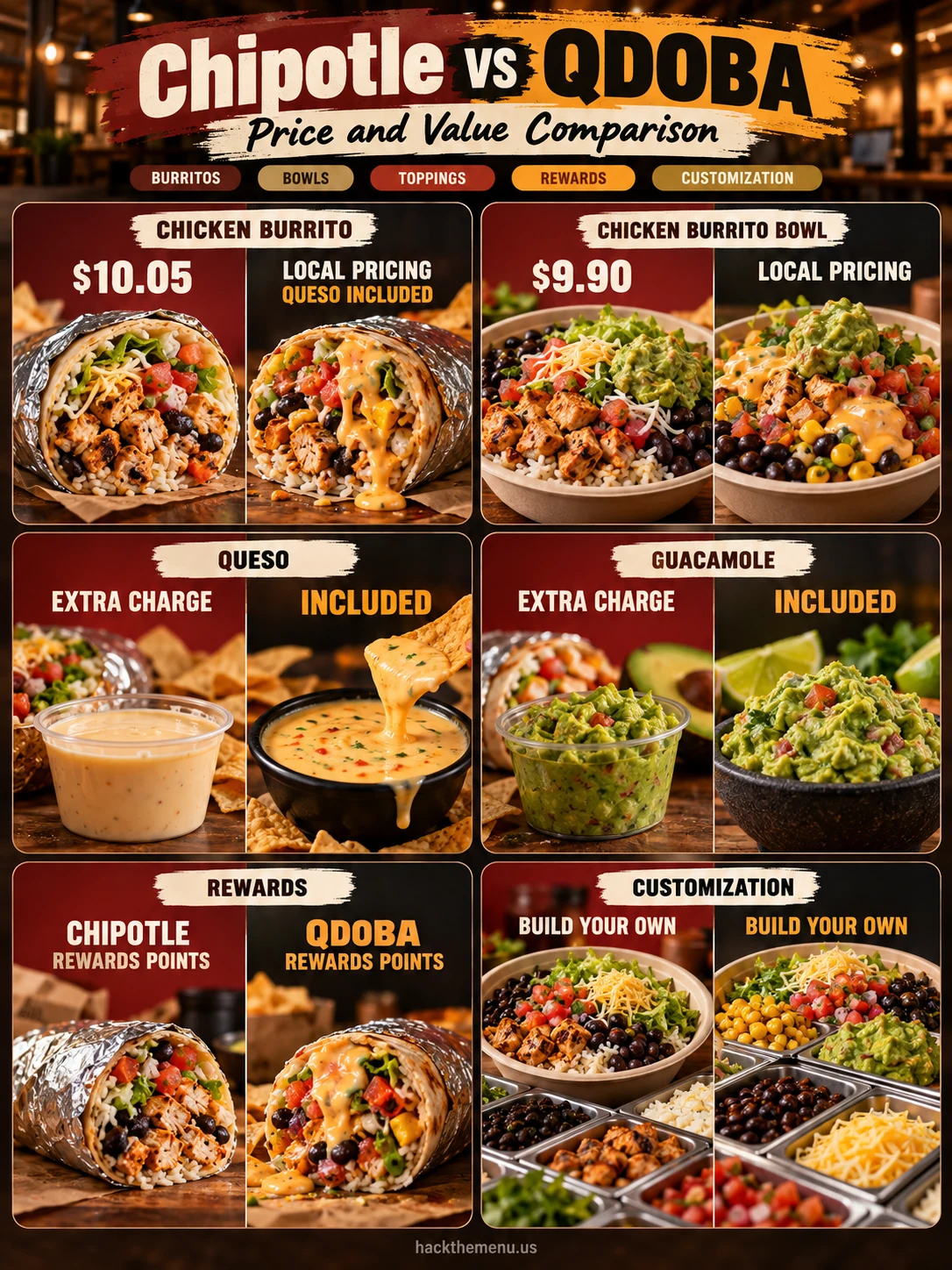
The most important price difference is often not the entrée itself. If your usual order includes guac and queso, QDOBA can package more of what you want into the base create-your-own price. If you skip those toppings, the advantage becomes smaller and the local base price matters more.
Chipotle’s official Rewards page confirms a 10-points-per-dollar earning structure and multiple redemption choices. Those points can be useful for repeat customers, but they should not be treated as an instant discount on every purchase. Compare the cash price first, then consider the rewards you are likely to redeem.
QDOBA’s official menu highlights more than 30 ingredients and states that the first portion of guac and queso is included on create-your-own entrées at no extra charge. That inclusion is especially important for bowls and burritos where both toppings would otherwise be premium add-ons at many competitors.
For another value benchmark, the Taco Bell vs Chipotle comparison shows how fast-casual entrée pricing differs from a restaurant built around many lower-ticket individual items. That is useful if your decision is more about total spend than burrito-to-burrito similarity.
Portions and Customization: Which Gives You More for the Money?
Both chains let you build a substantial entrée from rice, beans, protein, salsa, vegetables, cheese, and other toppings, so portion value depends heavily on what you select. A bowl can feel like a better deal than tacos when you want the ingredients concentrated into one large serving. A burrito can be more convenient, but the value still depends on protein and premium extras.
Chipotle is especially straightforward if you already know your preferred protein and topping combination. You can use the Chipotle secret menu for customization ideas, but add-ons and double portions can change the price quickly. The best value usually comes from choosing included ingredients deliberately rather than adding every premium option.
QDOBA emphasizes a wider flavor-combination pitch and includes guac and queso on create-your-own entrées, which can make a heavily topped bowl or burrito feel more complete without extra topping charges. The QDOBA secret menu is useful for customization ideas that stay within the chain’s normal ingredients. Extra portions can still cost more, so included does not mean unlimited.
If your goal is simply to find the lowest-cost Mexican-inspired restaurant meal, the cheapest Mexican fast food chains comparison provides a broader benchmark. Chipotle and QDOBA compete more on customizable entrée value than on having the cheapest single taco or snack.
Guacamole and Queso Can Change the Winner
QDOBA’s clearest built-in value advantage is simple: the first portion of guacamole and queso can be added to create-your-own entrées at no extra charge. If you would normally order both, that can be more meaningful than a small difference in the starting price of a burrito or bowl. Extra portions remain subject to charge.
Chipotle treats premium add-ons differently. Guacamole is not extra on a veggie entrée, but guac, queso blanco, double protein, and other additions can increase many other orders. This gives Chipotle customers flexibility, but it also makes it important to compare the fully configured cart rather than the base entrée alone.
Deals can temporarily change the result. The Chipotle happy hour and deals page is the place to check restaurant offers, rewards promotions, and deal patterns without mixing temporary promotions into the regular-price comparison.
The QDOBA happy hour and deals page serves the same purpose for QDOBA promotions and member offers. A useful reward can beat a small everyday price advantage, but only if it applies to the order you actually want.
Chipotle Rewards vs QDOBA Rewards
Chipotle Rewards earns 10 points for every eligible dollar spent in the restaurant, app, or online. Members can redeem through the Rewards Exchange for food and other options. The higher numerical earning rate does not automatically mean a better program because each brand defines its own point currency and redemption thresholds.
QDOBA Rewards earns 1 point per eligible dollar and converts 125 points into a free entrée for U.S. members under its published terms. Gold Status is tied to visit frequency and adds additional member benefits. This makes the program easy to understand because the free-entrée threshold is clearly stated.
The fast food rewards programs comparison helps put both systems in context. Focus on how much spending is required for a reward you will actually use, whether points expire, and whether your usual ordering channel earns credit.
Pickup, Apps, and Delivery Pricing
Pickup is the cleanest way to compare food value because delivery can add another layer of pricing. Chipotle states in its ordering materials that delivery pricing can be higher and fees can apply. QDOBA’s terms also warn that third-party delivery can include additional fees, surcharges, or higher menu prices.
QDOBA also promotes its app as a place to get its best pricing, customize orders, and earn or redeem rewards. Chipotle similarly centers much of its rewards and digital ordering experience in its app and website. The cheapest channel can therefore depend on both the menu price and the offer attached to your account.
Read Restaurant App Prices vs In-Store Prices if you regularly switch between counter ordering, pickup, and delivery. A few dollars in delivery markup or fees can outweigh the difference between the two restaurants’ base entrée prices.
Which Should You Choose for the Best Value?
Choose QDOBA first if you regularly want both guacamole and queso on a create-your-own entrée. That included first portion gives QDOBA a concrete value advantage before rewards are considered. Choose Chipotle first if you prefer its specific ingredient combinations, menu format, Rewards Exchange, or a local restaurant where the base price is meaningfully lower.
If you are trying to stay under a fixed spending limit, see the best fast food meals under $10 guide. Fast-casual burritos and bowls do not always fit the same budget as value-menu fast food, so a strict price ceiling can change the answer before portion size is even considered.
For another Mexican-chain comparison, the Taco Bell vs Del Taco price comparison focuses more heavily on low-cost tacos, burritos, bundles, and value menus. Comparing both styles helps separate “cheapest item” from “best complete entrée value.”
There is no universal winner across every city. Compare the same protein, desired toppings, and ordering method at both nearby restaurants. If guac and queso are must-haves, QDOBA often has the stronger structural value; if they are not, local base pricing and personal menu preference matter much more.
Frequently Asked Questions
Is QDOBA cheaper than Chipotle?
Not at every restaurant. Prices vary by location, protein, customization, and ordering channel. QDOBA can offer better built-in value when you want guac and queso because the first portion is included on create-your-own entrées.
Does QDOBA charge extra for guacamole and queso?
QDOBA says the first portion of guacamole and queso is included at no extra charge on create-your-own entrées at participating restaurants. Extra portions are subject to charge.
Does Chipotle charge extra for guacamole?
Guacamole can be an extra charge on many Chipotle orders, while a veggie entrée can include guac without the same extra charge. Promotions and rewards can also change the effective cost.
Which has better rewards, Chipotle or QDOBA?
The programs use different point currencies. Chipotle earns 10 points per eligible dollar and offers multiple redemption choices. QDOBA earns 1 point per eligible dollar and publishes a 125-point free-entrée threshold for U.S. members. The better program depends on the rewards you actually redeem.
Which gives larger portions, Chipotle or QDOBA?
There is no reliable chain-wide portion winner because build choices and restaurant preparation can affect the final serving. Both chains allow substantial burritos and bowls with multiple included ingredients. Compare the fully built entrée rather than only the container size.
Is Chipotle or QDOBA better for delivery?
Compare checkout totals rather than menu pages alone. Chipotle delivery pricing can be higher and fees may apply, while QDOBA notes that third-party delivery can add fees, surcharges, or higher menu prices. Pickup is usually the cleaner price baseline.
Which is better for a heavily customized bowl?
QDOBA can be especially attractive if the bowl includes both guacamole and queso because the first portion of each is included on create-your-own entrées. Chipotle can still be the better choice if you prefer its ingredients or local pricing. Extra portions and premium proteins can change either total.
For more restaurant price comparisons, rewards analysis, and ordering-cost guides, browse the Blog. Use the restaurant Menu pages for detailed item pricing and the comparison guides for deciding which chain better fits a specific budget or order style.