SANDWICH PRICE & VALUE COMPARISON
Subway vs Jimmy John’s: Which Is Cheaper?
Subway has the clearer advertised budget floor, while Jimmy John’s uses a straightforward Little John, 8-inch, and Giant 16-inch size ladder. Prices vary by restaurant, so the fairest comparison is the same meal size, pickup method, and add-ons at the locations you plan to use.
$3.99
Subway advertises selected 6-inch Deli Faves at this price at participating restaurants.
6-inch + Footlong
Subway’s familiar size structure makes small-versus-large budgeting easy to understand.
Little / 8” / 16”
Jimmy John’s offers Little Johns, regular 8-inch sandwiches, and Giant 16-inch options.
Local checkout
Restaurant pricing, extras, and delivery charges can change the final winner.
Price note: Subway and Jimmy John’s prices vary by restaurant, market, sandwich size, extras, and ordering channel. Promotional pricing and participation can also differ. Check the selected restaurant before ordering when a small price difference will affect your choice.
The Short Answer
Subway is the easier chain to start with when the goal is the lowest advertised sandwich price. It publishes participating-location offers such as selected 6-inch Deli Faves at $3.99 and a 6-inch Sub of the Day at $4.99. Jimmy John’s emphasizes its menu formats and restaurant-level ordering rather than one nationwide regular price table, so there is no responsible single number that proves it is always more expensive.
For a detailed item-by-item reference, the Subway menu with prices is the best place to compare 6-inch sandwiches, Footlongs, bowls, wraps, sides, and meal options. Subway can be especially competitive when a participating offer matches the sandwich you already want. Premium proteins, extras, and local pricing can still increase the basket.
The Jimmy John’s menu with prices is more useful when you want to compare Little Johns, regular 8-inch sandwiches, Giant 16-inch sandwiches, wraps, Unwich options, sides, and combos. A regular Jimmy John’s sandwich is longer than a Subway 6-inch, so comparing sticker prices without considering portion size can be misleading. Match the serving size and meal purpose before deciding which chain gives better value.
You can also browse the Sandwiches & Deli menu category when you want to compare these two with Jersey Mike’s, Panera Bread, and other sandwich chains. Sandwich value is shaped by bread size, protein amount, toppings, sides, and whether leftovers matter. The lowest menu number is only one part of the decision.
Subway vs Jimmy John’s Price Comparison
The most useful comparison separates advertised budget offers from normal restaurant-level pricing. Subway publishes several low-price entry points, while Jimmy John’s presents a simpler sandwich-size ladder and asks customers to order from a selected restaurant for the final total. The table below focuses on comparable shopping decisions rather than pretending every location uses the same menu price.
| Value area | Subway | Jimmy John’s | Value takeaway |
|---|---|---|---|
| Lowest advertised sandwich entry | Selected 6-inch Deli Faves advertised at $3.99 at participating restaurants | Regular prices depend on selected restaurant; Little Johns provide the smallest sandwich format | Subway has the clearer advertised floor |
| Smaller sandwich | 6-inch | Little John | Compare local price and appetite |
| Regular sandwich | 6-inch or Footlong depending on appetite | 8-inch Original, Favorite, or other sandwich | Jimmy John’s regular is not a direct 6-inch match |
| Large sandwich | Footlong | Giant 16-inch | Compare total food and leftovers |
| Meal structure | Participating meal promotions plus add-on chips, cookies, and drinks | Combos pair a sandwich or wrap with a side and drink | Compare complete basket |
| Delivery | Ordering-channel charges and participation can vary | Official site notes delivery menu prices may be higher and fees may apply | Pickup is the cleaner baseline |
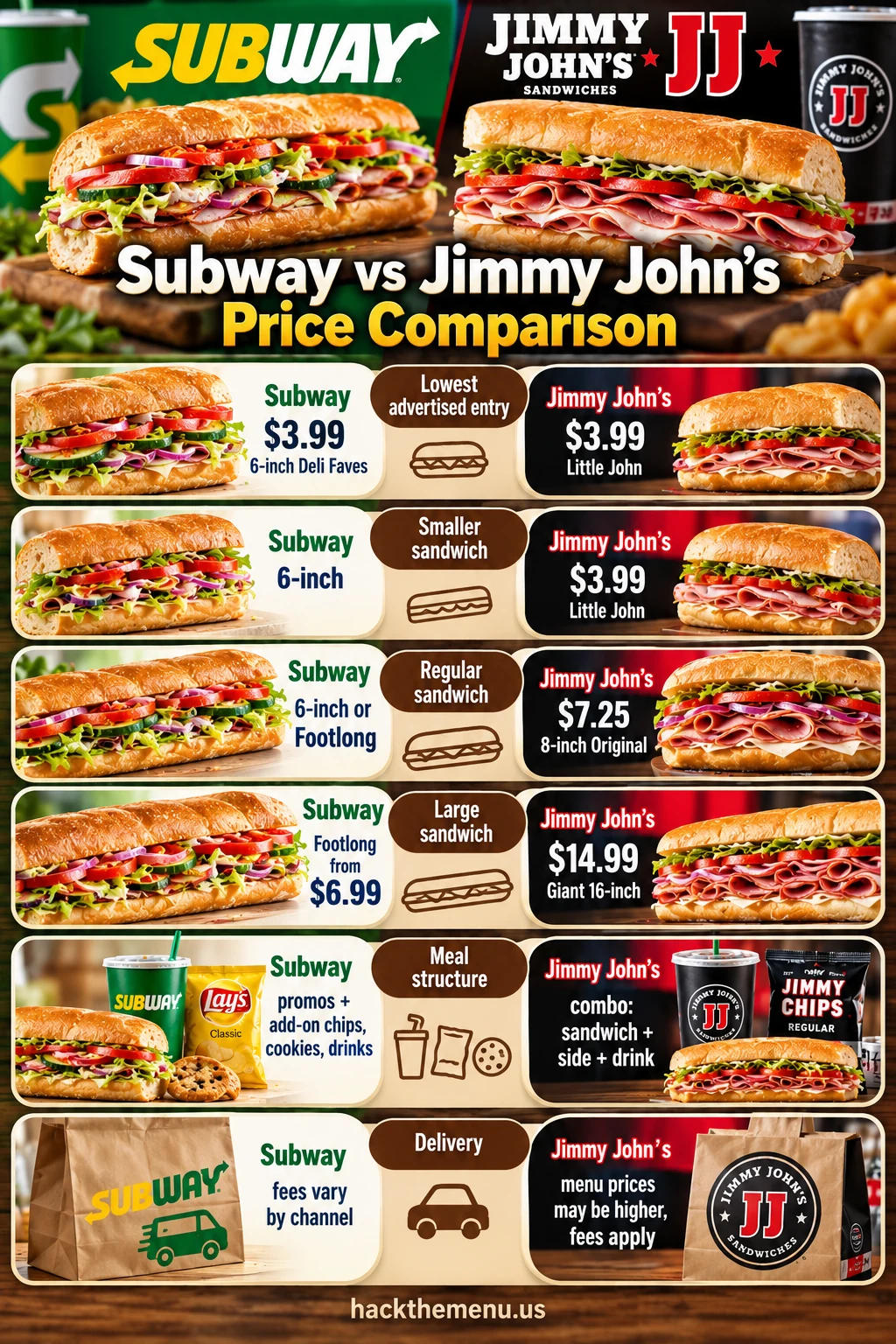
Subway wins the clearest low-price entry because a customer can see published promotional starting points without first building a full local order. That does not make every Subway sandwich cheaper than every Jimmy John’s sandwich. Jimmy John’s larger regular and Giant formats can make sense when portion size, sharing, or leftovers matter more than the smallest possible ticket.
The Subway vs Jersey Mike’s comparison provides another useful benchmark for Subway because Jersey Mike’s also uses a different size structure. That comparison shows why sandwich chains should be judged by equivalent serving formats rather than by one menu number. The same method applies here.
For a Jimmy John’s-focused comparison, the Jersey Mike’s vs Jimmy John’s price comparison is the natural next step. Both chains sell substantial deli-style subs, but their size labels and rewards systems differ. Comparing them helps put Jimmy John’s 8-inch and Giant formats in context.
Which Chain Gives You More Sandwich for the Money?
Size is the biggest reason a simple price comparison can fail. Subway’s familiar split is 6-inch versus Footlong, while Jimmy John’s also offers a smaller Little John, a regular 8-inch sandwich, and a Giant 16-inch. An 8-inch sandwich costing more than a 6-inch sandwich may still be reasonable if the portion and protein match your appetite better.
| Your priority | Start with | Why |
|---|---|---|
| Lowest advertised small sandwich | Subway | Participating 6-inch value offers create a clear budget entry |
| Compact light meal | Compare Subway 6-inch and Little John | Different lengths and fillings make local price important |
| Standard deli-style sandwich | Jimmy John’s 8-inch vs Subway optio ns | Compare actual sandwich size and ingredients |
| Large sandwich or leftovers | Compare Footlong and Giant | The Giant is 16-inch, so total food matters more than sticker price |
| Bread-free option | Jimmy John’s | Any sandwich can be ordered as an Unwich lettuce wrap |
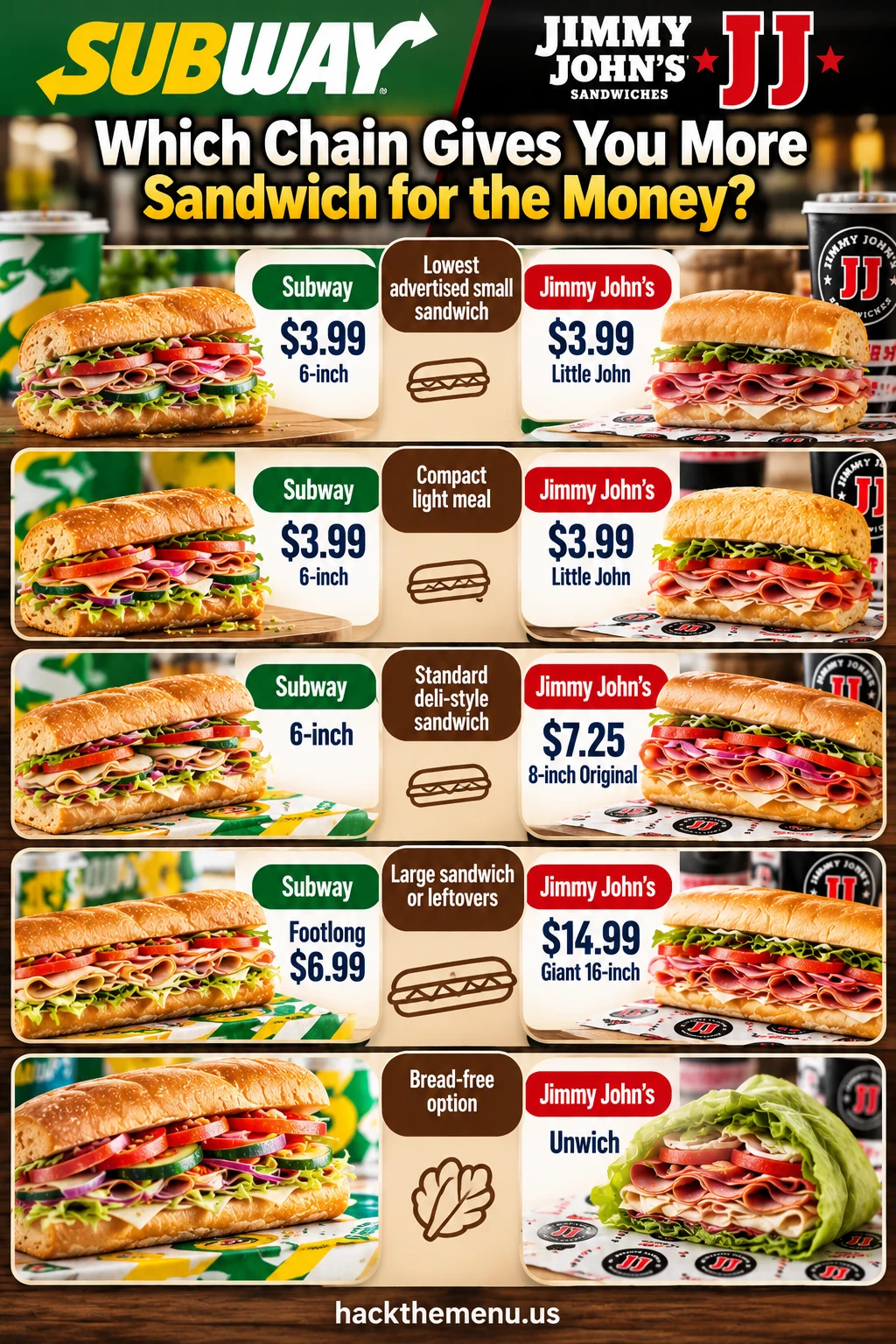
Subway is easier to scale down to a low-ticket purchase because its participating 6-inch offers are highly visible. Jimmy John’s gives shoppers a more graduated sandwich ladder from Little John to regular 8-inch to Giant 16-inch. The better value depends on how much food you actually need, not whether one chain uses a smaller number on its menu.
The Panera Bread vs Subway comparison is useful when your decision includes soups, salads, bakery items, or a café-style meal instead of only a sub. Subway tends to be simpler for a sandwich-first budget calculation. Panera changes the meal comparison by offering a broader café menu.
Which Is Better for a Budget Meal?
Subway has the stronger published budget story because it promotes multiple participating-location price points for smaller sandwiches and meal combinations. Jimmy John’s is easier to understand as a standard sandwich-plus-side-and-drink combo, but the final combo price depends on the restaurant. This makes Subway the better first check when you have a hard spending cap.
The cheapest sandwich chains comparison helps place both brands against other national options. A chain can be cheap for one small sandwich yet less competitive for a large combo. Compare the meal you actually intend to buy.
For a stricter dollar limit, the best fast food meals under $10 article focuses on complete meals rather than isolated entrée prices. That distinction matters because chips, cookies, drinks, and premium add-ons can turn an inexpensive sandwich into a higher checkout total. Start with the whole basket.
Deal timing can also shift value, so the Subway happy hour page is useful when promotional ordering is part of your decision. Local participation matters, and a deal that does not fit your preferred sandwich is not automatically good value. Compare the final eligible order.
Subway Rewards vs Jimmy John’s Rewards
Both chains use digital loyalty programs, but the programs should not be compared by a single point number. Subway’s Sub Club centers on member offers, perks, and repeat ordering, while Jimmy John’s Rewards lets members earn through purchases and redeem from available rewards. The economic value depends on what you buy and what reward you actually use.
The fast food rewards programs comparison explains why two loyalty currencies cannot be judged by point totals alone. A smaller reward you use frequently can be more valuable than a larger reward you rarely redeem. Compare required spending, eligible orders, and redemption choices.
Jimmy John’s also promotes rewards through its ordering ecosystem, while Subway connects many digital offers to member ordering. The practical approach is to compare the discounted checkout you can actually place rather than adding a theoretical loyalty value to every sandwich. Rewards matter most for repeat customers.
If deal availability is important, the Jimmy John’s happy hour page gives you another way to compare value-focused ordering. Use it alongside the regular sandwich price instead of assuming every promotion applies to every restaurant or order channel. Participation can vary.
Pickup vs Delivery: Which Is Cheaper?
Pickup is the cleaner baseline for comparing Subway and Jimmy John’s because delivery can introduce fees, higher menu pricing, or different promotion rules. Jimmy John’s explicitly notes that delivery menu prices may be higher than restaurant prices and that fees may apply. A small sandwich-price advantage can disappear once delivery charges are added.
The restaurant app prices vs in-store prices article explains why digital ordering channels can produce a different total from the counter. This is especially relevant when a Subway promotion requires online or app ordering or when a Jimmy John’s delivery menu differs from pickup. Compare identical baskets.
For the broad channel comparison, see pickup vs delivery pricing. Taxes, tips, delivery fees, menu markups, and promotion exclusions can outweigh a few dollars of entrée savings. Use pickup totals first if your goal is to compare the food itself.
Subway’s official ordering site lists participating offers and lets customers choose a restaurant before checkout; the official Subway site is the appropriate first-party place to confirm the selected location. Jimmy John’s similarly routes customers through its restaurant-level menu and ordering system. Avoid comparing a pickup coupon at one chain with a delivered regular-price basket at the other.
Which Should You Choose for Better Value?
Choose Subway first when your priority is the lowest published starting price, a smaller 6-inch meal, or an advertised digital offer that matches your order. Choose Jimmy John’s first when you prefer its 8-inch deli-style sandwiches, want a Giant for sharing or leftovers, or value the Little John and Unwich formats. Neither chain is automatically cheaper for every equivalent order.
Customization can change the result quickly. The Subway secret menu covers customization ideas that may add or swap ingredients, while the base menu remains the cleanest price benchmark. Compare the standard sandwich before adding extras.
The Jimmy John’s secret menu serves the same purpose for custom combinations and ordering tweaks. Extra meat, cheese, sides, or other modifications can raise the checkout total. Start with a comparable standard sandwich, then decide whether the customization is worth the added cost.
Jimmy John’s official menu page shows its sandwich categories, Little Johns, Giants, combos, sides, and other formats; use the official Jimmy John’s menu when you need first-party confirmation before ordering. For more restaurant value comparisons, browse the Blog. The final winner is the basket that fits your appetite and ordering channel at the lower local checkout total.
Frequently Asked Questions
Is Subway cheaper than Jimmy John’s?
Subway has the clearer advertised budget floor because it publishes participating-location offers for selected 6-inch sandwiches. Jimmy John’s regular prices depend on the selected restaurant and its standard sandwich is 8 inches, so there is no fair nationwide price proving Subway is cheaper for every comparable order. Compare the same meal size locally.
Which has the cheaper small sandwich?
Subway is easier to shop for a low-price small sandwich because it advertises selected 6-inch value offers. Jimmy John’s Little John is its compact sandwich format, but the exact local price depends on the restaurant. Portion and ingredients should be compared along with price.
Is a Jimmy John’s regular sandwich bigger than a Subway 6-inch?
Yes. Jimmy John’s describes its regular French-bread sandwiches as 8 inches, while Subway’s smaller standard format is 6 inches. That size difference is one reason sticker prices should not be compared without considering portion size.
Which chain is better for a large sandwich?
Compare Subway’s Footlong with Jimmy John’s Giant 16-inch rather than treating them as identical products. The Giant is longer, so the cheapest total price may not equal the lowest cost for the amount of food. Local pricing and leftovers matter.
Which rewards program is better?
There is no fair winner from point labels alone because the programs use different reward mechanics. Subway emphasizes member perks and digital offers, while Jimmy John’s Rewards lets members earn from purchases and redeem available rewards. Judge them by the rewards you actually use.
Does Jimmy John’s delivery cost more than pickup?
It can. Jimmy John’s states that delivery menu prices may be higher than restaurant prices and that fees may apply. Compare pickup and delivery checkout totals before deciding which option is cheaper.
Which is better for a budget meal?
Subway is the stronger first check for a strict budget because it publishes several participating-location entry offers and smaller sandwich price points. Jimmy John’s can still offer better value when its portion size or combo format fits your appetite better. The completed local basket should decide.