Best Pizza Delivery Chains
PIZZA DELIVERY CHAINS COMPARED
Best Pizza Delivery Chains
Pizza delivery chains differ in more than crust and toppings. Ordering apps, live tracking, rewards, delivery minimums, service fees, and local store participation can change which chain gives you the better delivery order. This comparison looks at six major options and separates delivery convenience from carryout pricing so the final checkout total stays at the center of the decision.
6 chains
Domino’s, Pizza Hut, Papa Johns, Little Caesars, Marco’s and Jet’s
Tracking matters
Order-stage updates and delivery visibility can vary by chain and store
Fees vary
Delivery fees, service charges and minimums are store-specific
Rewards differ
Points, challenges and reward redemption rules are not interchangeable
This page compares delivery systems and value, not just base pizza prices. For a price-first comparison across pizza brands, use the cheapest pizza chains page. Delivery charges, taxes, tips, minimums, menu pricing and participation can differ by store, so the checkout total is the number that matters.
What makes a pizza chain good for delivery?
A strong delivery chain needs more than a low advertised pizza price. The ordering flow should make it easy to see the delivery area, estimated timing, fees, deals, and reward eligibility before payment. Reliable status updates also matter because a cheap order is less appealing if you have no idea when it will arrive.
Rewards can change the value for repeat customers, but the earning rules deserve a closer look. Some programs exclude delivery fees from points, some require app ordering, and some rewards cannot cover the delivery charge itself. The Domino’s vs Pizza Hut comparison is useful when those two chains are the main choices in your area.
Menu depth is another practical factor. One household may want the lowest-cost large pizza, while another needs wings, pasta, sandwiches, desserts, or strong vegetarian options in the same order. A useful delivery comparison should account for the whole basket rather than one headline pizza price.
Pizza delivery chains compared
Each chain below has a different delivery strength. Domino’s puts heavy emphasis on tracking, Pizza Hut combines delivery with an app-centered rewards system, Papa Johns uses Papa Rewards and Papa Dough, Little Caesars keeps delivery tied closely to its value positioning, Marco’s allows reward certificates on eligible delivery orders, and Jet’s adds Detroit-style pizza with its own loyalty program. The table summarizes those differences before the chain-by-chain breakdown.
| Chain | Best for | Delivery strengths | Watch for |
|---|---|---|---|
| Domino’s | Order tracking | Detailed Tracker, GPS delivery visibility at eligible stores, broad digital ordering tools. | Local fees, minimums, deal eligibility and store participation. |
| Pizza Hut | App rewards | Hut Rewards, app challenges, online or app ordering, broad menu variety. | Points rules, delivery charges and location-specific offer terms. |
| Papa Johns | Simple loyalty value | Papa Rewards, Papa Dough, online and app ordering, delivery-focused deals. | Delivery fees do not earn points and store pricing can differ. |
| Little Caesars | Budget-focused delivery | Value-oriented pizza, app delivery ordering, app Challenges on eligible purchases. | Delivery, service and small-order fees can materially raise the total. |
| Marco’s Pizza | Rewards on delivery | My Rewards certificates can be applied to eligible delivery orders. | Delivery minimum still applies after discounts and the fee is not covered by rewards. |
| Jet’s Pizza | Detroit-style delivery | Detroit-style menu, local Hot Deals, Jet’s Rewards and delivery-related rewards. | Rewards have purchase thresholds, daily earning limits and point expiration. |
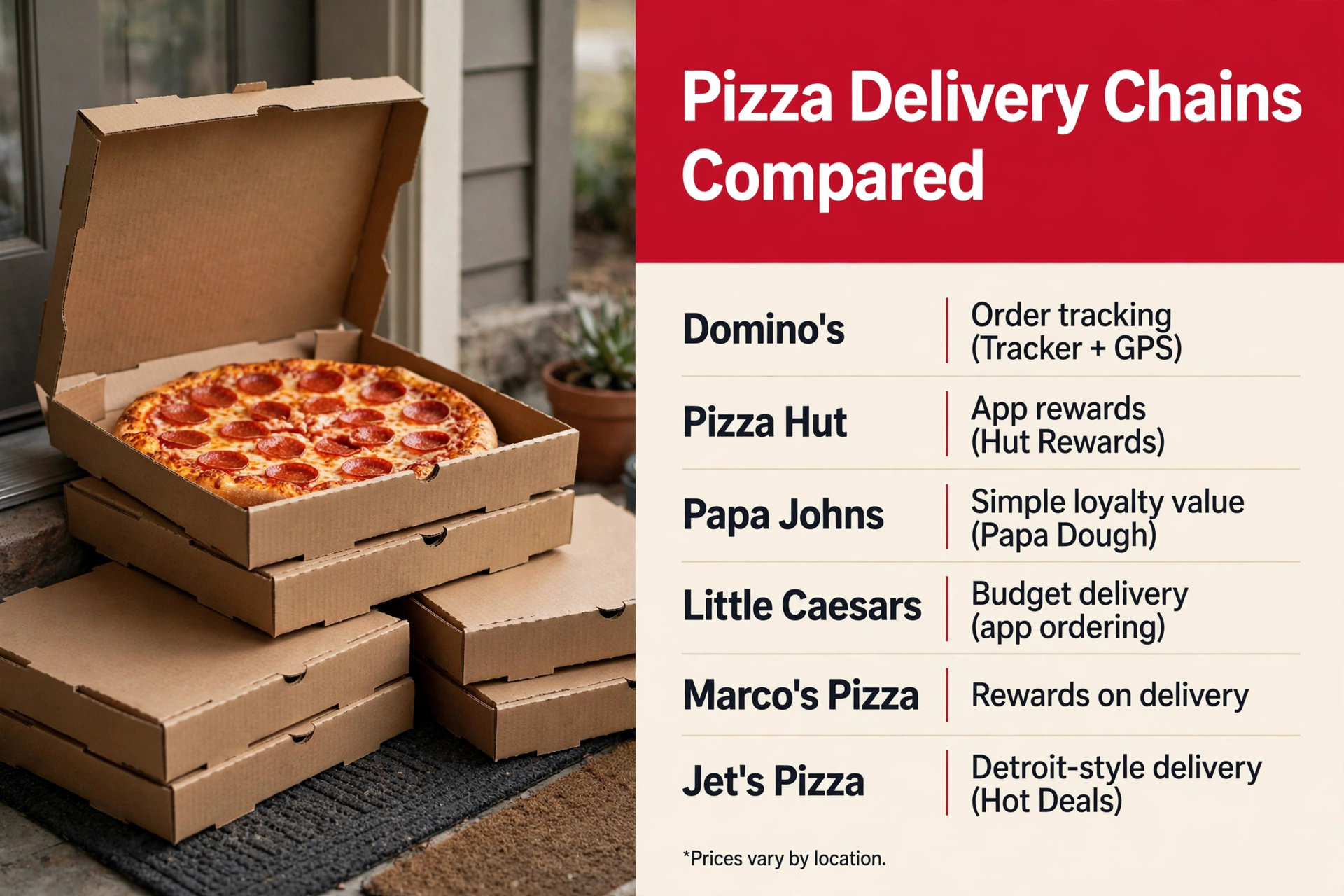
No chain wins every category. Domino’s can be stronger for tracking, while Marco’s can be attractive to repeat delivery customers who use rewards and Pizza Hut can appeal to app users who like challenges. The Little Caesars vs Domino’s comparison is useful if your decision is mostly about value between those two brands.
Domino’s: best for detailed delivery tracking
Domino’s stands out for order visibility. Its Tracker follows the order from placement through preparation and the oven, and eligible deliveries can add GPS progress once the driver leaves the store. Domino’s also updated the Tracker with more precise ready-time estimates and clearer progress information, which makes it easier to time a delivery without repeatedly checking the door.
The chain also gives customers a wide mix of digital ordering tools, local coupons, and a rewards program tied to eligible purchases. The official Domino’s Tracker page explains the order-stage and GPS features. For savings rather than tracking, the Domino’s specials page covers the main deal structure.
Domino’s is a strong fit when delivery visibility matters as much as the menu. Still, the final price depends on the selected store, delivery fee, local coupons, and basket size. The Domino’s menu is the better place to compare regular food prices before adding delivery charges.
Pizza Hut: best for app-based rewards and challenges
Pizza Hut’s delivery system is closely tied to Hut Rewards. Members earn points on eligible menu spending, and the app adds challenges and exclusives that can accelerate rewards or create account-specific offers. That makes Pizza Hut appealing to customers who order repeatedly and are willing to use the app rather than treating every purchase as a one-off transaction.
Pizza Hut says members earn 10 points for each eligible whole dollar spent, with reward choices shown in the account. The official Hut Rewards page also explains that app challenges and exclusives can have their own terms. For deal-focused ordering, the Pizza Hut coupons page keeps promotions separate from this delivery comparison.
The main caution is that delivery value depends on the selected restaurant. Delivery charges, minimums and discount eligibility can change the final total, and reward points should not be treated as a substitute for checking the checkout price. The Pizza Hut menu is useful for comparing the base basket before fees.
Papa Johns: best for straightforward loyalty value
Papa Johns keeps its loyalty structure easy to understand at the earning stage. Members earn points on eligible food spending, and those points convert into Papa Dough that can reduce the cost of future menu items. Delivery fees, taxes and tips do not count toward point earning, so the loyalty value comes from the food subtotal rather than the full delivered total.
Papa Dough can be applied to eligible orders, and Papa Johns also publishes delivery and carryout deals through its ordering system. The conversion and promotional details can change, so the account is the safest place to see how much Papa Dough is available before checkout. The Papa Johns deals page covers those savings options in more detail.
Papa Johns is a good fit for customers who want a familiar delivery flow with a simple spend-and-earn program. It also has a broad national footprint, although individual store pricing and delivery charges still matter. The Papa Johns menu gives the regular-price baseline for pizza, wings, sides and desserts.
Little Caesars: best for budget-focused delivery
Little Caesars built its reputation around carryout value, but delivery can still work well when convenience matters more than the lowest possible pickup total. Delivery is available from participating restaurants through digital ordering, and the chain states that delivery, service and small-order fees may apply. Orders below the delivery threshold can also trigger a small-order charge.
The Little Caesars app adds Challenges that can reward qualifying pickup or delivery purchases placed through the app. Third-party orders do not qualify for those Challenge rewards, which makes the ordering channel important. The Little Caesars promo-code page explains the chain’s deal mechanics, while the Little Caesars menu gives the standard food-price context.
Little Caesars is most attractive when the starting pizza price is low enough that delivery fees do not erase the advantage. For very small orders, the fee structure deserves extra attention because delivery can change the economics quickly. Larger family orders may absorb those fees more easily across multiple pizzas or sides.
Marco’s Pizza: best for using rewards on delivery
Marco’s gives repeat customers a useful delivery-specific benefit because My Rewards certificates can be applied to eligible delivery orders. Members earn one point per eligible dollar, and the program issues a $5 certificate after 50 points. The certificate does not cover the store’s delivery fee, and the discounted food subtotal still has to meet the store’s delivery minimum.
That structure is valuable when you already order Marco’s often enough to generate certificates. Points themselves do not expire under the published program rules, while issued certificates have a shorter redemption window. The Marco’s coupons page covers deal and promo-code savings beyond the loyalty program.
Marco’s is a strong fit when you want delivery and expect to return to the chain regularly. The biggest caution is to check the post-discount subtotal before relying on a reward, since using a certificate can push the order below a delivery minimum. This is a good example of why reward value and delivery eligibility need to be checked together.
Jet’s Pizza: best for Detroit-style delivery fans
Jet’s is the most style-specific choice in this comparison because its Detroit-style square pizza is a major part of the brand’s identity. The chain also publishes local Hot Deals after a store is selected, so delivery value can vary meaningfully by market. That makes Jet’s especially appealing when the product style matters as much as the delivery system.
Jet’s Rewards adds 10 points at enrollment and then awards points on eligible purchases that meet the program’s minimum order requirement. The terms also impose a daily earning cap and a 180-day expiration window on unused points. Reward options can include food and delivery-related benefits, so regular customers should check the Marketplace before paying full price for extras.
Jet’s is not as geographically widespread as the largest national chains, which means availability can be the first filter. Where it is available, it offers a distinct pizza style plus a loyalty program and local deal structure. Compare the selected store’s Hot Deals with the full delivery checkout rather than assuming a local coupon automatically gives the lowest total.
How to compare the final pizza delivery price
The advertised pizza price is only the first number in a delivery order. Delivery fees, service charges, minimums, premium toppings, taxes and tips can change which chain is cheaper. Rewards can lower the food subtotal, but they often do not reduce the delivery fee itself.
| Cost factor | Why it matters | What to compare |
|---|---|---|
| Food subtotal | Deals can require specific sizes, toppings or multiple items. | Price the exact basket you want at each chain. |
| Delivery fee | Usually varies by store and may not be covered by rewards. | Check the fee after selecting the delivery address. |
| Service or small-order fee | Can make small orders disproportionately expensive. | Look for minimum-order or small-basket charges. |
| Reward eligibility | Some programs exclude fees or third-party orders from earning. | Check the qualifying food subtotal and ordering channel. |
| Tip | Adds to the true delivered cost even when it is not part of the restaurant fee. | Include it when comparing delivery with carryout. |
| Local coupon | Can beat a national deal but may have narrow requirements. | Compare the discounted total, not only the headline offer. |

For a pure price comparison without the delivery-service layer, use the cheapest pizza chains page. Delivery changes the calculation because the cheapest menu can become more expensive after fees. The right comparison is the completed basket at the address and time you actually plan to order.
How to choose the right pizza delivery chain
Choose Domino’s when detailed tracking is the priority, Pizza Hut when app challenges and rewards matter, Papa Johns when you prefer a simple loyalty currency, Little Caesars when a low starting food price matters most, Marco’s when delivery-friendly reward certificates fit your habits, and Jet’s when Detroit-style pizza is the deciding factor. Those are category strengths rather than permanent rankings.
Availability should come before preference because delivery zones differ by restaurant. A chain may serve one neighborhood while another stops a few blocks away, and third-party delivery can use different prices or reward rules from ordering direct. Compare direct ordering first when loyalty points or restaurant-specific deals are part of the decision.
The Blog section has more restaurant deal and comparison articles if you want to compare app savings, carryout offers or menu value separately. Keeping those questions separate makes it easier to see whether the pizza itself, the delivery system or the loyalty program is driving the better choice.
Frequently Asked Questions
Which pizza chain has the best delivery tracking?
Domino’s has the strongest tracking-focused setup in this comparison. Its Tracker follows order progress through preparation and delivery, and eligible stores can add GPS visibility after the driver leaves the restaurant.
Which pizza delivery chain has the best rewards?
The answer depends on how you order. Pizza Hut emphasizes app challenges, Papa Johns uses Papa Dough, Marco’s lets eligible reward certificates work on delivery, and Jet’s has a points marketplace with food and delivery-related rewards.
Is Little Caesars delivery still cheap after fees?
It can be, especially on a larger order, but delivery, service and small-order fees can narrow the price advantage. Compare the completed delivery basket with carryout before deciding.
Do pizza delivery fees earn rewards points?
Often not. Papa Johns and Marco’s exclude delivery charges from point earning, and other programs also define eligible food spend separately from fees, taxes and tips.
Can pizza rewards cover the delivery fee?
That depends on the program. Marco’s says its reward certificates do not apply to the delivery fee, and many restaurant loyalty programs limit rewards to food or eligible menu items.
Is ordering direct cheaper than DoorDash or Uber Eats?
It can be, but there is no universal rule. Direct restaurant ordering is often better for chain-specific rewards and coupons, while third-party pricing, fees and promotions can follow different terms.
Which pizza chain is best for a small delivery order?
A low food subtotal is useful only if the chain does not add a large fee or small-order charge. Price the exact basket at your address because delivery minimums and fees can outweigh a cheap pizza.
Should I use delivery or carryout for the lowest pizza price?
Carryout usually avoids the delivery fee and can unlock pickup-only offers. Delivery makes more sense when convenience is worth the extra cost or when a chain-specific delivery promotion narrows the gap.