Chipotle Custom Orders
Chipotle Secret Menu: 12 Hacks & How to Order
Build practical Chipotle combinations from standard entrées, sides, and exact ingredient requests. Availability, portions, and charges vary by restaurant.
Use menu terms instead of relying on a viral nickname.
Ordering Base
5 entrée paths
Burrito, bowl, tacos, salad, or a digital quesadilla.
Practical List
12 builds
Use standard ingredients or assemble the finished idea yourself.
Quesadilla
Digital order
Select the restaurant and place the full-size order online.
Best Script
Name ingredients
A precise build is easier to enter than a nickname.
Quick Answer
Chipotle does not offer a permanent nationwide secret menu with hidden register buttons. Most Chipotle secret menu ideas are unofficial combinations of the same burritos, bowls, tacos, salads, quesadillas, ingredients, and sides that appear in the normal ordering system. The reliable method is to describe each component, accept the selected restaurant’s limits, and assemble unusual combinations after pickup when needed.
Start with an orderable base, then add only the ingredients or sides the restaurant displays. For normal entrée formats and local price context, use the Chipotle menu page; for other restaurant customizations, browse the Secret Menus archive. A viral name can help you remember a recipe, but it should never replace a clear ordering script.
12 Chipotle Secret Menu Builds
The table separates an orderable component from the fan nickname attached to it. Read the Order or Assemble column first, because it tells you what to select or say without requiring staff to recognize the finished name. The final column flags requests that can change the price, require self-assembly, or depend on the restaurant’s workflow.
| Build | How to Order or Assemble | Best Channel | Reality Check |
|---|---|---|---|
| DIY Nachos | Order chips plus bowl ingredients or sides, then assemble after pickup. | Counter or digital | Chips are a side, not a guaranteed bowl base. Queso, guac, and extra protein may add charges. |
| Spicy Queso Dip | Order Queso Blanco and tomatillo-red chili salsa on the side, then mix gradually. | Counter or digital | You control the heat. Keep the cups separate until you find the balance you want. |
| Dragon Sauce | Order sour cream and tomatillo-red chili salsa on the side, then stir them together. | Counter or digital | This is a fan nickname. Ask for the two ingredients instead of the name. |
| Double-Wrapped Burrito | Ask whether an extra flour tortilla can be used around a standard burrito. | Counter request | An extra tortilla or special handling may cost more, and the restaurant may decline. |
| Bowl With a Side Tortilla | Build a burrito bowl and add a flour tortilla on the side when offered. | Counter or digital | Make one smaller burrito and keep the remaining bowl intact. Side-item charges vary. |
| Half-and-Half Bowl | Ask for a split of white and brown rice, black and pinto beans, or another simple pair. | Counter request | Use exact ingredients. Portion policy and digital controls differ by restaurant. |
| Mixed-Protein Bowl | Request a split between two proteins and ask how the register will price it. | Counter request | A split is not a promise of two full portions. The total may reflect an extra-protein charge. |
| Taco Trio Sampler | Order tacos and request different fillings only when the ordering channel supports each taco. | Counter or digital | If separate editing is unavailable, keep one base build and vary the salsa or side dips yourself. |
| Double-Decker Taco | Order one crunchy taco plus a soft flour tortilla with cheese, then stack them yourself. | Self-assembly | Treat both components as separate ordered items. Do not assume staff can assemble the nickname. |
| Burritodilla-Style Quesadilla | Order a digital quesadilla with protein or fajita veggies and use its sides as burrito-style fillings. | Digital order | The supported version is a quesadilla, not a filled burrito pressed on the line. |
| Quesarito-Style Pairing | Order a burrito and a cheese quesadilla separately, then combine bites or assemble carefully. | Digital plus standard order | A burrito wrapped in a quesadilla is labor-intensive and is not a dependable request. |
| Three-Pointer-Style Entrée | Choose a very short ingredient list and ask for the register total before the order is finished. | Counter request | Point rules are not shown on the guest menu. Do not assume a nickname, formula, or discount. |
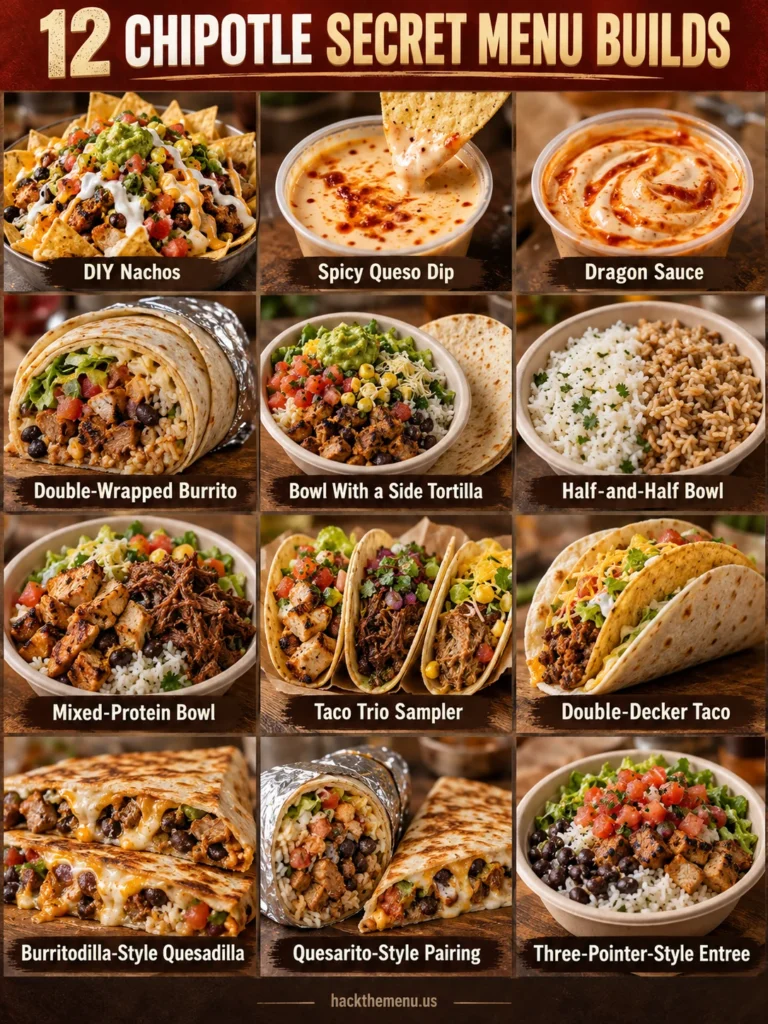
The easiest builds are DIY Nachos, Spicy Queso Dip, Dragon Sauce, and a bowl with a side tortilla because they keep preparation inside standard items. Double-wrapping, split portions, mixed proteins, and limited-ingredient pricing need a short conversation before the order is made. If the goal is value rather than novelty, compare the Chipotle happy hour page before paying for several premium extras.
How Chipotle’s Ingredient System Works
Chipotle is built around an entrée format followed by a sequence of ingredients. The usual paths are a burrito, burrito bowl, tacos, salad, or a full-size quesadilla placed through a digital channel. Rice, beans, proteins, fajita veggies, salsas, dairy toppings, guac, Queso Blanco, lettuce, tortillas, and chips then shape the finished meal.
That structure makes custom ordering flexible, but it does not turn every combination into a recognized product. The full Chipotle menu breakdown helps identify the base entrée before you experiment with side cups or split ingredients. Begin with the base, move through the line in its normal sequence, and save unusual assembly for the table at home.
- Base first: Choose burrito, bowl, tacos, salad, or digital quesadilla before naming toppings.
- Protein second: State one protein, a vegetarian base, or ask whether a split portion is supported.
- Build in line order: Rice and beans come before salsas, dairy toppings, guac, queso, and lettuce.
- Sides last: Request chips, a tortilla, or sauce cups only after the main entrée is clear.
A short ingredient script is easier to repeat back than a nickname and gives the cashier a chance to explain a charge. It also prevents a custom build from becoming a surprise pile of extra portions. If a modifier is missing from the app or the restaurant declines a line request, choose the closest standard version instead of arguing for an internet recipe.
Bowl and Burrito Builds That Travel Well
Bowl With a Side Tortilla
A bowl with a side tortilla is the most practical DIY burrito setup. Order the bowl with the rice, beans, protein, salsa, and toppings you want, then add a flour tortilla only if it appears as a side or the cashier confirms it. Transfer a moderate amount into the tortilla so it can fold without tearing, and leave wet salsa or sour cream in the bowl until the final bites.
This approach gives you control over filling order and portion size without asking the line to make a nonstandard object. A side tortilla may carry a charge, so treat it as a separate item rather than a free entitlement. For another chain where exact ingredient language matters, the Subway secret menu uses the same principle of naming the build instead of assuming a nickname is universal.
Double-Wrapped and Half-and-Half Requests
A double-wrapped burrito uses a second tortilla around the same filling. Ask whether the restaurant can add the tortilla and confirm its price before ingredients are piled on, because the request can affect both workflow and the register. Keep the filling controlled, since an overloaded burrito still becomes difficult to close even with another wrap.
Half-and-half requests are simpler when they involve one clear pair, such as white and brown rice or black and pinto beans. Say “half white rice and half brown rice” rather than “both rices,” which can sound like two full portions. Split protein deserves a separate price check because the restaurant may treat it differently from a simple split of rice or beans.
Mixed Protein Without a Surprise Charge
Ask for half of one protein and half of another, then pause for the cashier to confirm how the portion will be entered. Do not assume the combination means two full scoops for the price of one or that every digital interface supports the split. If the total is higher than expected, choose one protein or add a clearly priced extra portion rather than relying on an unwritten rule.
Quesadilla-Style Builds and Viral Names
Chipotle’s full-size quesadilla is an orderable entrée, but it follows the app or website path rather than a normal walk-up line order. Choose the restaurant, select the quesadilla, add an offered protein or fajita veggies, and select the available sides. This supported format is the safest starting point for anything described online as a Burritodilla.
A Practical Burritodilla
Order a quesadilla with a filling offered in the digital menu and choose sides that create the burrito profile you want. Add rice, beans, salsa, sour cream, or guac in small bites after pickup instead of asking staff to press a fully loaded burrito. The result keeps the melted cheese and toasted tortilla while avoiding a request the restaurant’s equipment may not support.
A Practical Quesarito
A fan-style Quesarito is usually described as a burrito wrapped in a cheese quesadilla. That assembly is bulky, labor-intensive, and not a dependable register item, so order the burrito and quesadilla separately if you want the pairing. Combine manageable pieces yourself, and expect the total to reflect two ordered components rather than a hidden bargain.
Do not confuse this request with the packaged Quesarito associated with another chain. The Taco Bell secret menu explains that restaurant’s customization language, while Chipotle’s version should stay anchored to a digital quesadilla and a separately orderable burrito. Clear separation prevents staff from guessing which recipe you mean.
DIY Nachos, Tacos, and Side-Cup Mixes
DIY Nachos
Order chips, then choose bowl ingredients or side cups that will hold up during transport. Queso Blanco, beans, protein, salsa, sour cream, guac, and lettuce can be layered in small amounts, but keeping wet ingredients separate protects the chips from becoming soft. Assemble only the portion you plan to eat and leave the remaining chips dry.
Spicy Queso and Dragon Sauce
For Spicy Queso, mix tomatillo-red chili salsa into Queso Blanco a little at a time. For Dragon Sauce, blend the same red salsa with sour cream until the heat and texture suit you. Both names are fan shorthand, so the restaurant request is simply for the individual side cups.
Taco Trio and Double-Decker Taco
A taco order can become a sampler when the ordering channel allows each taco to be edited separately. If it does not, use one consistent filling and vary the salsa or side dip after pickup. For a double-decker effect, place a crunchy taco inside a soft tortilla with cheese, but order those pieces separately and handle the final assembly yourself.
How to Order in the Chipotle App
Begin on Chipotle’s official ordering page or in the app, select the restaurant, and choose the normal entrée closest to the build. Work through only the controls shown for that item, because the selected restaurant and channel determine which proteins, toppings, sides, and portions can be entered. Review every modifier and the running total before placing the order.
- Select the restaurant: The item list and available modifiers depend on that location.
- Choose the supported base: Use a bowl for DIY nachos, a burrito for double-wrap planning, or a quesadilla for a pressed format.
- Add visible modifiers: Pick only the proteins, rice, beans, salsas, toppings, and sides offered on screen.
- Check the cart: Confirm premium ingredients, extra portions, side items, pickup method, and total before paying.
Do not place an unsupported construction request in a generic note and assume the kitchen can follow it. A missing control often signals that the modifier is unavailable through that ordering path. The same discipline helps with the Dunkin’ secret menu, where selecting a supported base and visible modifiers produces a more repeatable result than a nickname.
How to Order at the Counter
At the counter, keep the request in the same order as the ingredient line. Name the entrée first, then rice, beans, protein, vegetables, salsas, dairy toppings, guac or queso, and lettuce. Pause after a split portion, extra tortilla, mixed protein, or unusual side request so the employee can confirm whether it is supported and how it will be charged.
- Use one request at a time: Let the employee finish each step before adding the next modifier.
- Ask before special handling: Double wraps and split proteins should be discussed before the burrito is assembled.
- Accept a clear limit: Equipment, line speed, ingredient supply, and store policy can rule out a request.
- Check the receipt: Confirm every premium topping, side, and extra portion before leaving the register.
Polite ingredient-first ordering is more useful than presenting an online recipe as an entitlement. The Chick-fil-A secret menu follows a similar rule: ask for standard products and supported changes, then accept the restaurant’s operational limits. If the line is busy, choose a simple side-cup build that requires less explanation.
Prices, Charges, and Portion Requests
There is no single Chipotle secret menu price. The total begins with the selected restaurant’s entrée price and can change with extra protein, guac, Queso Blanco, tortillas, side cups, or a separately ordered quesadilla. Delivery menus and third-party services can also show a different total from pickup or counter ordering.
Treat “extra” and “half” as different requests. Half of two proteins may describe one combined portion, while extra protein asks for more food and can add a charge; the cashier or cart determines which interpretation applies. Extra rice, beans, salsa, or cheese may be limited by portion policy even when a separate line-item charge is not displayed.
The Three-Pointer nickname is especially risky as a pricing promise. Chipotle has referenced three-point meals in promotional terms, but it does not publish a universal guest-facing ingredient chart that guarantees a formula at every register. Order a short ingredient list, ask for the total, and decide based on the actual price rather than an online claim.
For comparison, the Wendy’s secret menu also shows why a custom total should be checked after every add-on. Restaurant pricing systems attach charges to orderable components, not to a fan’s expectation of what a nickname should cost. A build is successful only when the receipt matches the items you agreed to buy.
Availability and Channel Limits
A supported ingredient can still be unavailable at a selected restaurant. The app may hide an item, a side may be sold out, a digital-only entrée may not be enterable at the counter, or a special handling request may not fit the restaurant’s workflow. These limits are normal parts of a made-to-order system, not proof of a separate hidden menu.
Build a fallback before ordering. A quesadilla-style request can become a standard digital quesadilla, a Quesarito can become a burrito plus cheese on the side, and nachos can become chips with separate dips. If you want another example of channel-specific customization, the Starbucks secret menu shows how visible app controls and store availability set the practical boundary.
Do not base the recipe on a rotating protein, sauce, or topping unless it is displayed for the chosen restaurant. A standard base with rice, beans, a listed protein or Sofritas, regular salsas, and familiar toppings is easier to repeat. When a component disappears from the menu, replace it with another displayed choice instead of treating the old combination as guaranteed.
Nutrition and Allergen Considerations
Custom builds can change calories, sodium, saturated fat, carbohydrates, protein, and allergen exposure quickly. A second tortilla, full quesadilla, extra protein, Queso Blanco, guac, sour cream, cheese, chips, and several side cups all alter the meal. Use Chipotle’s nutrition calculator to enter the full base and every modifier rather than estimating from a nickname.
For an allergy, check each component separately and account for shared preparation areas. A tortilla, sauce, dairy topping, vinaigrette, protein, or limited offering can introduce a concern that is not obvious from the finished nickname. Tell restaurant staff about the allergy before ordering, but do not treat customization as a guarantee against cross-contact.
Diet labels also depend on the complete build. Rice, beans, vegetables, many salsas, chips, and guac can fit plant-based orders, while cheese, sour cream, queso, meat, and honey-containing dressings require closer review. Choose ingredients from the restaurant’s displayed tools and skip any combination whose information does not meet your needs.
Viral Names That Create Confusion
Quesarito, Burritodilla, Three-Pointer, Dragon Sauce, and Double-Decker Taco are memory aids, not a universal staff vocabulary. Two people can use the same name for different fillings, portions, or assembly methods. Ingredient language removes that ambiguity and gives the restaurant a concrete order to enter.
The most labor-heavy names also create the greatest chance of refusal. A fully loaded burrito pressed as a quesadilla, a burrito wrapped inside another hot item, or several full portions described as “half and half” can conflict with equipment and portion rules. Use a supported quesadilla, separate components, or self-assembly as the fallback.
Nickname confusion appears across chains, including the McDonald’s secret menu, where a remembered label may refer to more than one sandwich combination. The fix is the same at Chipotle: name the base, list the changes, verify the total, and repeat the order back before paying. That sequence makes the recipe portable even when the nickname is not.
Common Ordering Mistakes
The first mistake is leading with a nickname and adding ingredients only after the employee looks confused. The second is asking for several special portions at once, which makes it difficult to separate a split from an extra. The third is assuming a social-media price overrides the selected restaurant’s register or digital cart.
- Do not ask staff to invent a register button for a fan name.
- Do not assume a side tortilla, extra scoop, premium topping, or separate entrée is free.
- Do not request digital-only quesadilla preparation through the main line.
- Do not overload a burrito and expect a second tortilla to solve every folding problem.
- Do not ignore cross-contact simply because the ingredient list looks suitable.
- Do not argue when equipment, supply, portion policy, or workflow prevents a modification.
A good custom order is easy to repeat and easy to price. Use one base, a short set of changes, and a fallback that stays within the menu. Save the most unusual assembly for after pickup, where you control the portions and do not slow the line.
More Restaurant Custom-Order Ideas
Chipotle’s strongest combinations come from a flexible ingredient line, but other restaurants reward a different kind of planning. Use each chain’s own menu terms, keep substitutions modest, and verify the final order before paying. The two pages below focus on builds that can be translated into standard products and modifiers.
Frequently Asked Questions
Does Chipotle have a secret menu?
Chipotle does not present a permanent nationwide hidden menu. The phrase usually refers to unofficial combinations made from normal entrée formats, ingredients, and sides. The most dependable approach is to order by ingredient and assemble unusual combinations yourself.
Will Chipotle employees recognize secret-menu names?
Recognition is not guaranteed. Names such as Dragon Sauce, Burritodilla, and Quesarito are fan shorthand rather than dependable register buttons. State the base entrée, ingredients, side cups, and requested modification in a clear order.
How do I order Chipotle nachos?
Order chips with bowl ingredients or side cups and assemble the nachos after pickup. Queso Blanco works as the melted-cheese component, while salsa, beans, protein, sour cream, and guac can be added in small amounts. Do not assume the restaurant will place chips inside a bowl or build the nachos for you.
Can I order a Quesarito at Chipotle?
You can ask, but a burrito wrapped in a quesadilla is not a dependable menu request. The practical alternative is to order a burrito and a cheese quesadilla separately, then pair them yourself. This route respects the digital quesadilla process and makes every charge visible.
What is a Chipotle Burritodilla?
A Burritodilla is a fan name for a burrito-like filling pressed in a quesadilla format. The supported ordering path is a digital quesadilla with an available protein or fajita veggies and the offered sides. Do not expect staff to press a full burrito or recognize the nickname.
What is a Chipotle Three-Pointer?
The Three-Pointer is a nickname for a limited-ingredient entrée that may receive different register treatment. Chipotle does not show a universal guest-facing point chart, so online formulas are not reliable ordering rules. Ask for the ingredients you want and confirm the total before paying.
Can I order a Chipotle quesadilla at the counter?
Chipotle directs full-size quesadilla orders through its app or website. Choose the restaurant, select Quesadilla, add an offered filling, and pick the available sides. A counter may not be set up to enter or prepare that entrée on the main line.
Does Chipotle charge for extra secret-menu ingredients?
It can. Extra protein, guac, Queso Blanco, tortillas, sides, or unusual portion requests may change the total, while other toppings may be included under local portion rules. Review the cart or ask for the register total before the order is completed.
Can I mix two proteins at Chipotle?
A restaurant may allow a split protein request, but the portion and price are not universal. Ask for half of each protein and confirm whether the register treats the combination as a standard portion or an extra. If the digital menu does not offer a split, choose one protein or add a clearly priced extra portion.
Are Chipotle secret-menu builds safe for food allergies?
No custom build can eliminate shared-kitchen cross-contact. Review every tortilla, protein, sauce, topping, and side in Chipotle’s nutrition and allergen tools, then tell restaurant staff about the allergy before ordering. Skip the order when the available information or preparation process does not meet your needs.
Ordering Notes
Chipotle secret menu combinations are unofficial custom orders, not a promise of hidden products, prices, portions, or nationwide participation. Use the selected restaurant’s ordering system, ingredient list, and register total to decide what is available. This independent site is not affiliated with or endorsed by Chipotle Mexican Grill.
The safest pattern is simple: choose a listed base, name each modifier, confirm premium charges, and assemble unusual layers yourself. Save the recipe in ingredient order so it can be repeated without the nickname. If a restaurant cannot support the build, choose the nearest standard entrée and keep the meal easy to prepare.