PIZZA PRICE & VALUE COMPARISON
Pizza Hut vs Papa Johns: Which Offers Better Value?
Papa Johns has the slightly lower advertised starting point for a two-item value order, while Pizza Hut offers more distinct solo and family bundle formats. Prices, participation, crust upgrades, toppings, and delivery charges vary by restaurant, so the best value depends on the basket you actually build.
$7 each
Pizza Hut Deal Lover’s Menu applies when you choose two or more eligible favorites.
$6.99 each
Papa Pairings applies when you choose two or more eligible Papa Johns items.
10 pts / $1
Hut Rewards earns 10 points per eligible whole dollar spent.
$1 / $10
Papa Rewards turns every 10 eligible points into $1 of Papa Dough.
Price note: Pizza Hut and Papa Johns use restaurant-level pricing and participation rules. Premium crusts, extra toppings, taxes, delivery charges, and regional pricing can raise an advertised deal price. Check the selected restaurant before ordering.
The Short Answer
Papa Johns has the lower advertised two-item starting price by one cent per item. Papa Pairings lists eligible items at $6.99 each when you choose two or more, while Pizza Hut’s Deal Lover’s Menu lists two or more eligible favorites at $7 each. That one-cent gap is too small to settle every order, so eligibility and food quantity matter more than the headline difference.
For pizza sizes, crusts, toppings, and restaurant-level pricing, start with the Pizza Hut menu with prices. Pizza Hut’s value is spread across several formats, including Deal Lover’s Menu, Melts, My Hut Box, Dinner Box, and Big Dinner Box. A bundle that matches your appetite can beat a slightly cheaper per-item deal.
The Papa Johns menu with prices is the matching reference for pizzas, wings, sandwiches, bread sides, desserts, and local offers. Papa Pairings is especially useful because the eligible list crosses several menu categories. That flexibility can make the lower $6.99 starting point more practical for a mixed order.
Browse the Pizza menu category when you want to compare these chains with Domino’s, Little Caesars, and other pizza restaurants. Pizza value changes with size, crust, topping count, sides, and how many people are eating. Compare similar order types instead of unrelated specials.
Pizza Hut vs Papa Johns Price Comparison
The most useful comparison starts with each chain’s promoted value structures because regular menu prices differ by restaurant. Pizza Hut uses a $7 two-or-more menu plus solo and family formats, while Papa Johns uses $6.99 Papa Pairings alongside store-specific specials. The table below shows how those structures compare before upgrades, taxes, and delivery charges.
| Value area | Pizza Hut | Papa Johns | Value takeaway |
|---|---|---|---|
| Two-item deal | Deal Lover’s Menu: $7 each for 2+ eligible items | Papa Pairings: $6.99 each for 2+ eligible items | Papa Johns by one cent per item |
| Solo meal format | Melts and My Hut Box formats | Personal pizzas and Pairings choices vary by restaurant | Pizza Hut has clearer dedicated solo formats |
| Family order | Dinner Box and Big Dinner Box structures | Build with pizzas plus Pairings sides, wings, sandwiches, or desserts | Compare food quantity and headcount |
| Rewards earning | 10 points per eligible $1 | 1 point per eligible $1; 10 points = $1 Papa Dough | Different reward currencies |
| Delivery baseline | Fees and restaurant pricing vary | Fees and restaurant pricing vary | Carryout is the cleaner comparison |
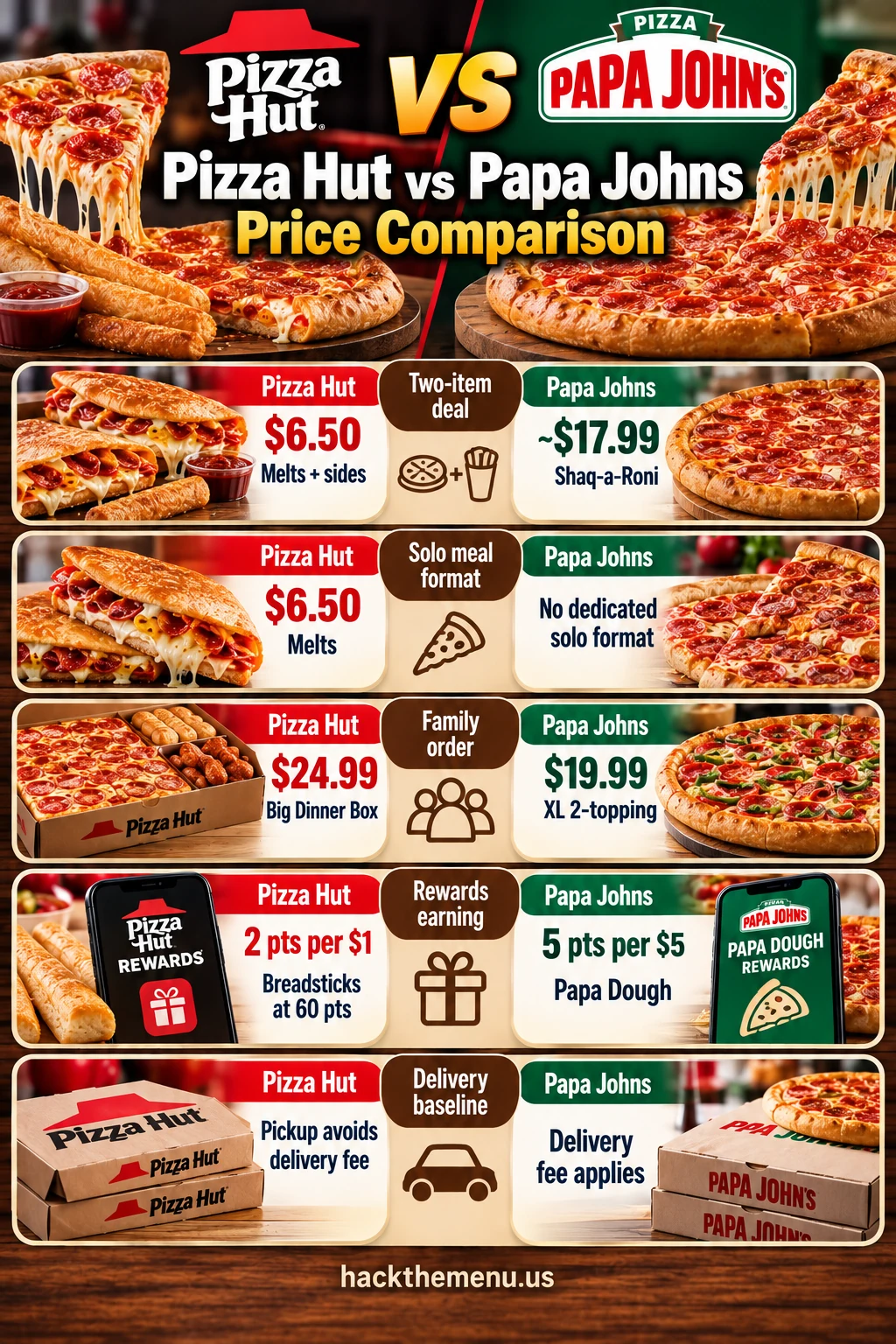
Papa Johns wins the narrow two-item headline comparison, but the difference is only two cents on a two-item basket. Pizza Hut can still be the better value when a Melt, My Hut Box, or Dinner Box matches the order more closely. A bundle that includes food you would otherwise buy separately can outweigh a one-cent per-item difference.
Pizza Hut publishes its first-party value structures on the official Pizza Hut deals page. Papa Johns explains its matching two-or-more structure on the official Papa Pairings page. Both brands make restaurant selection important because participation and pricing can vary.
The Domino’s vs Pizza Hut comparison provides another benchmark for Pizza Hut’s $7 deal structure. It is useful when you are deciding whether the penny-level difference between national pizza deals actually matters. Coupon fit often matters more than the smallest advertised number.
Which Has the Better Two-Item Deal?
Papa Johns has the mathematical edge because Papa Pairings begins at $6.99 per eligible item, compared with $7 for Pizza Hut’s Deal Lover’s Menu. On two items, the advertised difference is only two cents. That is too small to matter if one chain’s eligible item list fits your order better or an upgrade costs extra.
Papa Pairings can include medium 1-topping pizzas, wings, bread sides, sandwiches, and desserts, which makes it useful for mixed baskets. Pizza Hut’s Deal Lover’s Menu also spans several favorites, but the exact eligible products and charges can vary. Compare the complete cart instead of assuming every $7 or $6.99 choice delivers the same quantity.
The Domino’s vs Papa Johns comparison shows how Papa Pairings performs against another $6.99 pizza deal structure. If you are choosing among three major delivery chains, comparing the same two-item basket at each restaurant is more useful than comparing unrelated promotions. Size and crust rules can change the apparent winner.
Deal-focused customers can also compare the Pizza Hut happy hour page for additional value opportunities. Keep deal pricing separate from regular-menu pricing because a promotion may require a particular ordering channel or product combination. The final checkout total is the number that matters.
Solo Meals and Family Value
Pizza Hut has the clearer dedicated solo-meal structure because it promotes formats such as Melts and My Hut Box alongside standard pizzas. That can be useful when one person wants a defined entrée rather than buying two items to unlock a value menu. Papa Johns can still compete through personal pizzas and Papa Pairings choices, depending on the selected restaurant.
| Your priority | Start with | Why |
|---|---|---|
| Lowest two-item starting price | Papa Johns | Papa Pairings starts at $6.99 each for 2+ eligible items |
| Defined solo meal | Pizza Hut | Melts and My Hut Box create clearer single-person formats |
| Family box format | Pizza Hut | Dinner Box and Big Dinner Box organize a larger group order |
| Mixed pizza-and-side basket | Compare both | Eligible product lists differ even when starting prices are close |
| Large group order | Compare local checkout | Pizza size, side count, crust, and fees drive per-person value |
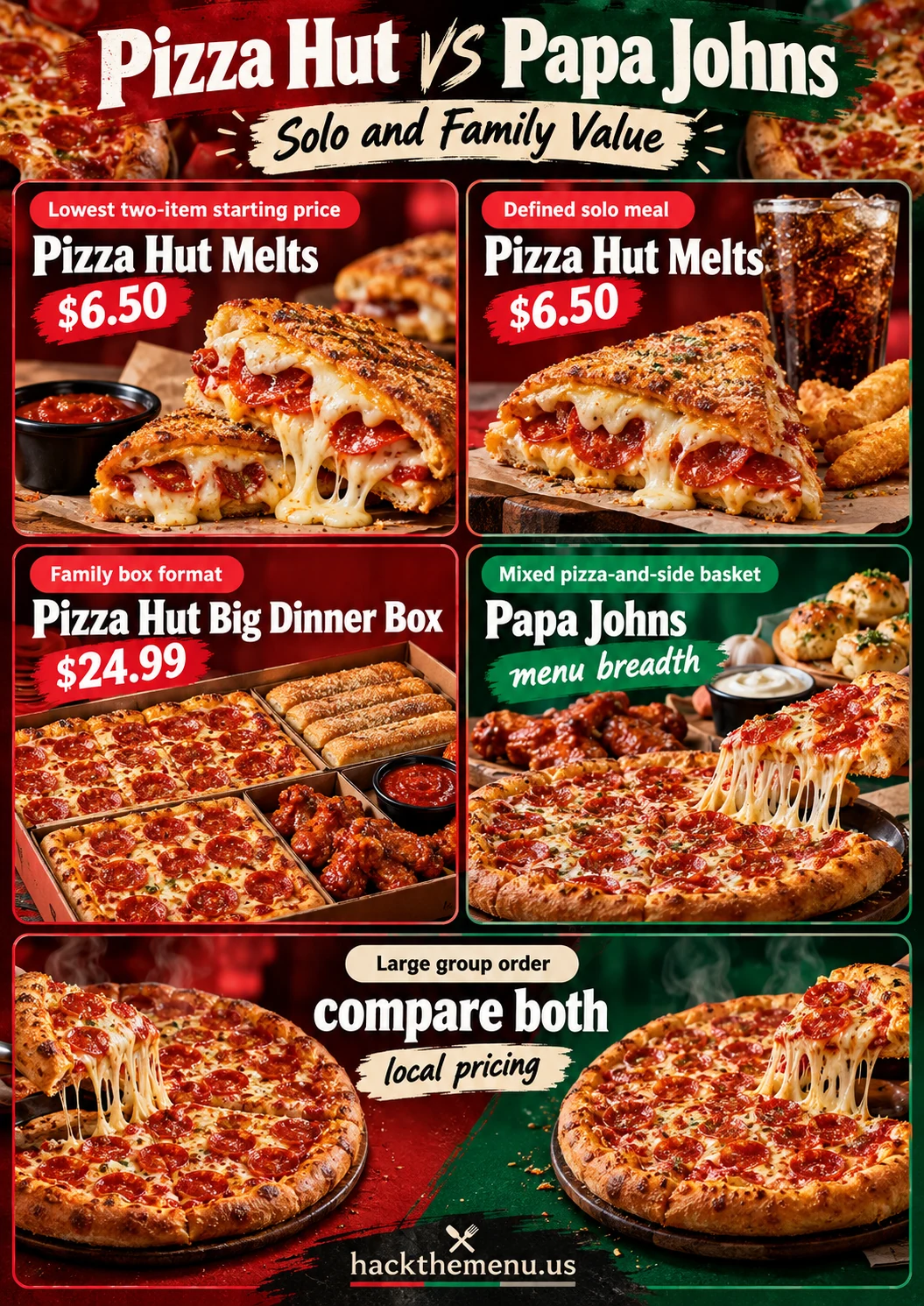
Pizza Hut’s box formats can be easier to evaluate when the listed combination already matches a family’s plan. Papa Johns can be more flexible when the group prefers separate pizzas, wings, bread sides, sandwiches, or desserts under Pairings. Paying slightly more for the right combination can cost less than buying unwanted bundle components.
The cheapest pizza deals for feeding a family article compares value from a headcount perspective. That approach is helpful because family orders should be judged by how many people the food serves, not only by the first advertised price. Leftovers and side quantity can also affect value.
For a wider chain-level comparison, see the cheapest pizza chains breakdown. Different pizza brands win different basket types, and a coupon-heavy chain may not always have the lowest regular-menu price. Use the selected restaurant when a small difference will change your choice.
Hut Rewards vs Papa Rewards
The rewards programs use different point currencies. Hut Rewards earns 10 points for every eligible whole dollar spent and lets members redeem points for free menu items, with reward choices beginning at published point thresholds. Papa Rewards earns 1 point per eligible dollar and automatically converts every 10 points into $1 of Papa Dough.
Papa Rewards is easy to value because its points convert directly into a dollar-denominated reward balance. Hut Rewards can deliver different value depending on which free-food redemption you choose, so its nominal 10-points-per-dollar rate should not be compared directly with Papa Johns’ one-point-per-dollar rate. The reward currency is different even though both use points.
The restaurant rewards programs comparison explains how to compare loyalty systems with different earning units and redemption rules. Focus on the reward you are likely to use and the eligible spending needed to reach it. A high point number does not automatically mean a better return.
Visit the Papa Johns happy hour page when offers matter more than base pricing. Rewards and promotions can overlap differently by restaurant and ordering channel. Use the savings that reduce your actual cart rather than chasing points you may not redeem.
Carryout vs Delivery Costs
Carryout is the cleaner baseline for comparing Pizza Hut and Papa Johns because delivery can add charges, minimums, tips, or different menu pricing. A one-cent per-item advantage disappears immediately if delivery costs differ by more than a few cents. Compare the same fulfillment method whenever possible.
The restaurant app prices vs in-store prices article explains why digital pricing and coupon eligibility can change the checkout total. Pizza chains rely heavily on online offers, which makes the ordering channel especially important. Always review the complete cart before paying.
The pickup vs delivery price comparison provides a broader framework for deciding whether convenience fees erase a menu-price advantage. The same logic applies to pizza delivery. If price is the priority, compare pickup first and treat delivery as a separate convenience purchase.
Which Should You Choose for Better Value?
Choose Papa Johns first when the eligible Papa Pairings items closely match your order and you want the lowest advertised two-item starting point. Choose Pizza Hut first when a Melt, My Hut Box, Dinner Box, or Big Dinner Box is a better fit than building a basket one item at a time. The one-cent difference between the two-item menus should not outweigh a meaningful difference in food quantity.
Customization can change the result quickly. The Pizza Hut secret menu shows how unofficial combinations can alter a standard order, while premium crusts and extra toppings may change the total. Compare the regular version first so customizations do not hide the base value.
The Papa Johns secret menu serves the same purpose for Papa Johns custom orders. Extra ingredients, specialty crusts, sauces, and add-ons can make a value-menu item more expensive. Use standard configurations when you want the cleanest comparison.
For more restaurant price comparisons and budget-focused ordering topics, browse the Blog. The strongest value choice is the basket that feeds the right number of people without paying for food or upgrades you did not want. Local checkout remains the final price check.
Frequently Asked Questions
Is Pizza Hut cheaper than Papa Johns?
Not for every order. Papa Pairings starts at $6.99 per eligible item when you choose two or more, while Pizza Hut’s Deal Lover’s Menu starts at $7 each. Bundle fit, pizza size, crust upgrades, toppings, and fees can reverse the small headline difference.
Which has the better two-item deal?
Papa Johns has the lower advertised starting price by one cent per eligible item. The difference is only two cents on a two-item basket, so the eligible product list matters more. Compare the exact pizzas and sides you want.
What is Pizza Hut’s Deal Lover’s Menu?
It is a two-or-more value structure that lists eligible favorites at $7 each. Product availability, prices, participation, and additional charges can vary by restaurant. Review the selected restaurant before ordering.
What is Papa Johns Papa Pairings?
Papa Pairings lets customers choose two or more eligible favorites at $6.99 each. Eligible choices can include medium 1-topping pizzas, wings, bread sides, sandwiches, and desserts. Restaurant participation and availability can vary.
Which chain is better for one person?
Pizza Hut has clearer dedicated solo formats through products such as Melts and My Hut Box. Papa Johns can still be competitive when a personal pizza or two Pairings items fit the appetite. Compare the amount of food you will actually eat.
Which rewards program gives better value?
They use different currencies, so the raw point totals are not directly comparable. Hut Rewards earns 10 points per eligible dollar and redeems points for menu rewards, while Papa Rewards earns 1 point per eligible dollar and turns every 10 points into $1 Papa Dough. The better program depends on your spending and redemption choices.
Is carryout cheaper than delivery?
Carryout is usually the cleaner price baseline because delivery can add fees, minimums, tips, or different pricing conditions. Those costs can easily erase a small menu-price advantage. Compare the final checkout total for both fulfillment methods before ordering.