Panda Express vs P.F. Chang’s
Panda Express vs P.F. Chang’s: Prices and Portions Compared
Panda Express builds quick-service meals around fixed side-and-entrée formats, while P.F. Chang’s offers a broader casual-dining menu with appetizers, full entrées, noodles, rice and shareable choices. Prices vary by restaurant, so the fairest comparison matches portion size, sides and ordering method before judging value.
1 / 2 / 3
Panda Bowl, Plate and Bigger Plate entrée counts
5 people
Panda family meal format with large sides and entrées
2 servings
P.F. Chang’s nutrition lists many main entrées as two servings
2 styles
Quick-service meal building versus casual-dining ordering
Price note: Both restaurants can vary by location, order channel, upgrades and add-ons. Compare the selected restaurants before ordering, especially when matching a quick-service meal against a full-service entrée.
Which Restaurant Usually Gives Better Value?
Panda Express usually makes value easier to judge because the meal structure is standardized around a side plus one, two or three entrées. The Panda Express menu lets you compare Bowl, Plate and Bigger Plate formats without building every component separately. That structure works well when your priority is a predictable quick meal.
P.F. Chang’s serves a different use case. The P.F. Chang’s menu includes appetizers, wok-fired entrées, noodles, rice, sushi-style items, desserts and other casual-dining choices, so a higher basket total may also represent a larger or more shareable order. The better value depends on whether you want one fast individual meal or a broader restaurant-style meal.
For a simple lunch or dinner for one, Panda Express has the clearer value framework. For two people sharing starters and entrées, P.F. Chang’s can make more sense when the food is divided across the table. Browse the Asian restaurant menu category when you want more comparable Chinese and Asian-style menus.
Panda Express vs P.F. Chang’s Price Structure
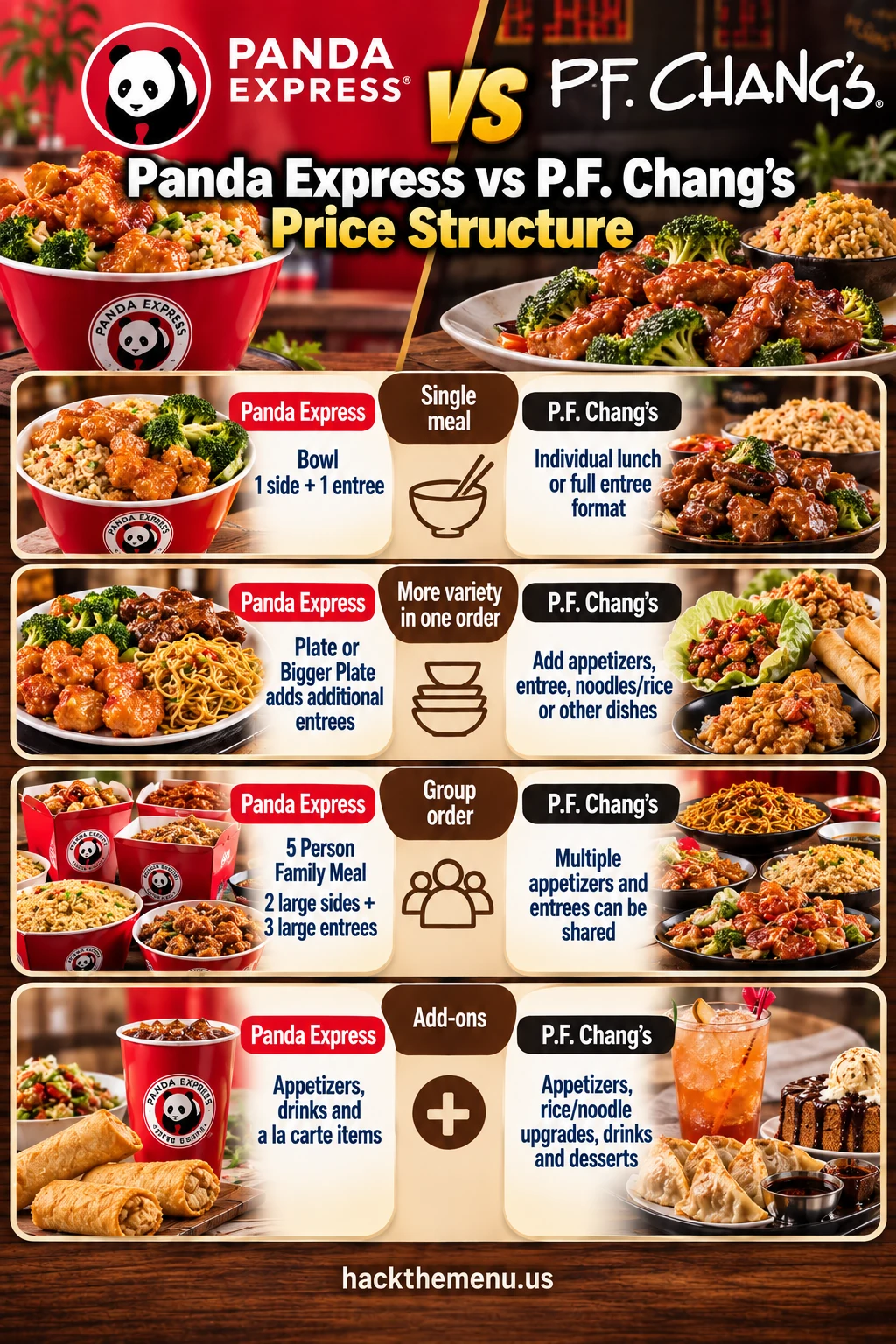
The two restaurants price meals differently, so a single entrée-to-entrée comparison can be misleading. Panda Express packages a side and entrée count into familiar meal formats, while P.F. Chang’s separates appetizers, entrées and upgrades more like a casual-dining restaurant. Use the table to compare how each ordering system builds the final bill.
| Comparison point | Panda Express | P.F. Chang’s | Value takeaway |
|---|---|---|---|
| Single meal | Bowl: 1 side + 1 entrée | Individual lunch or full entrée format | Panda has the simpler built-in meal structure |
| More variety in one order | Plate or Bigger Plate adds additional entrées | Add appetizers, entrée, noodles/rice or other dishes | Compare total food, not item count alone |
| Group order | 5 Person Family Meal: 2 large sides + 3 large entrées | Multiple appetizers and entrées can be shared | Match diners and portions before comparing totals |
| Add-ons | Appetizers, drinks and à la carte items | Appetizers, rice/noodle upgrades, drinks and desserts | Extras can change either basket quickly |
Panda’s fixed meal formats reduce the number of decisions required to build a complete order. That can make it easier to stay within a target budget, especially if you are comparing ideas from fast-food meals under $10. P.F. Chang’s requires a more deliberate basket comparison because appetizer, entrée and upgrade choices can change the total substantially.
The most useful method is to decide the number of diners first, then compare enough food for the same group. This is the same principle used when comparing combo meals with à la carte ordering: the lower starting item price does not always produce the lower completed basket.
How Do the Portions Compare?
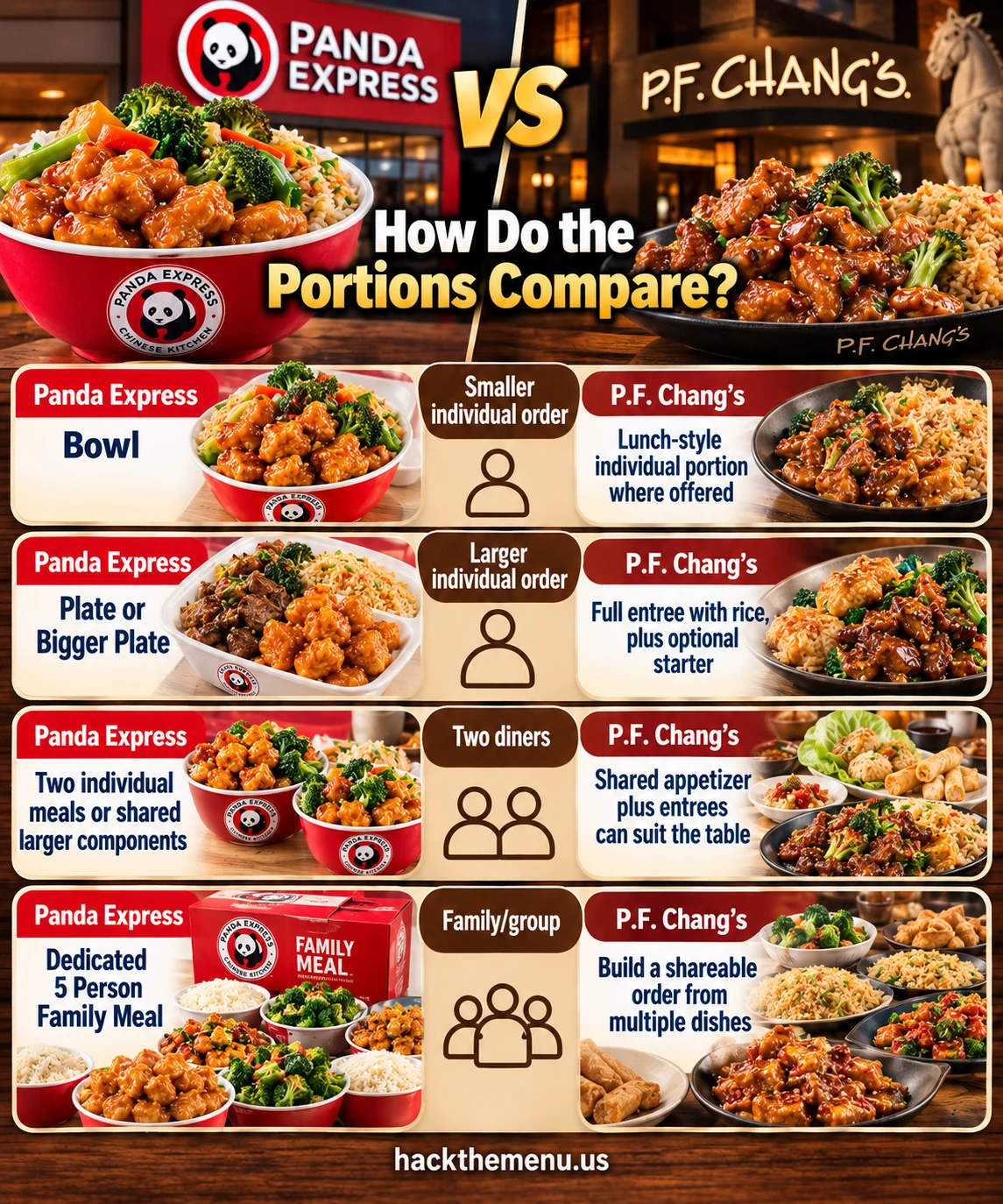
Panda Express defines portions through meal slots. A Bowl has one side and one entrée, a Plate keeps one side and adds a second entrée, and a Bigger Plate adds a third entrée. The family format scales that system to two large sides and three large entrées for a five-person meal.
P.F. Chang’s portions need a different reading. Its nutrition information states that appetizers, salads, main entrées, noodles and rice commonly use two servings in the nutrition table, even though the way people divide a dish varies by appetite and order. That makes sharing behavior an important part of the price comparison.
| Order type | Panda Express | P.F. Chang’s | How to compare |
|---|---|---|---|
| Smaller individual order | Bowl | Lunch-style individual portion where offered | Compare entrée, base and included sides |
| Larger individual order | Plate or Bigger Plate | Full entrée with rice, plus optional starter | Compare how much will actually be eaten |
| Two diners | Two individual meals or shared larger components | Shared appetizer plus entrées can suit the table | Compare a complete two-person basket |
| Family/group | Dedicated 5 Person Family Meal | Build a shareable order from multiple dishes | Compare total food and leftovers |
The biggest mistake is treating a Panda entrée slot and a P.F. Chang’s full entrée as identical units. A portion comparison should include the base, number of entrées, side dishes and whether food will be shared. For broader budget planning, the family meal versus individual meals comparison explains why packaging matters as much as sticker price.
Where Panda Express Has the Value Advantage
Panda Express is strongest when you want a fast, self-contained meal with a clear portion format. Bowl, Plate and Bigger Plate make it easy to decide how many entrée choices you want before you start adding extras. That structure also makes Panda relevant when comparing the cheapest fast-food chains, although local restaurant pricing still determines the actual checkout total.
The menu also works well for mixed preferences because one Plate can split its entrée slots between different dishes. Customers who like custom combinations can also review the Panda Express secret menu for ordering and customization ideas that use normal menu components. Those modifications can affect value if premium entrées or extra items are added.
Panda’s five-person meal creates another clear use case. Instead of assembling several separate Bowls or Plates, a group can compare one family-format basket with the cost and quantity of individual meals. The best fast-food family meals for the money page provides more context for that kind of group-order decision.
Where P.F. Chang’s Can Offer Better Value
P.F. Chang’s can be the better fit when value means variety, table sharing and a broader restaurant experience rather than the lowest individual meal structure. Main entrées are served with steamed white or brown rice, and the menu also offers appetizers, noodles, fried rice, sushi-style choices and desserts. A group can distribute several dishes across the table instead of buying one isolated meal per person.
That sharing model matters most for couples and families. A higher-priced entrée may contribute to more than one diner’s meal, so dividing the full basket by the number of people can give a more useful value measure. Compare that approach with restaurant meals for a family of four on a budget rather than judging only the entrée line item.
P.F. Chang’s also has more ways to expand an order, which can be either a benefit or a budget risk. Appetizers, noodles, desserts and premium dishes add variety but can push the total upward quickly. The P.F. Chang’s secret menu page is useful when you want customization ideas without assuming that every variation is a standard named item.
Pickup, Delivery and App Pricing
Ordering channel can change the final comparison even when the food is identical. Restaurant apps and websites may show location-specific prices, while delivery can add fees, tips or channel-specific menu pricing. The restaurant app versus in-store price comparison explains why the same order can produce different totals.
For a fair test, compare both restaurants using the same fulfillment method. If one basket is pickup and the other is third-party delivery, the result measures service fees as much as food value. See the pickup versus delivery comparison before deciding which restaurant is cheaper for an off-premise order.
Location matters for the same reason. Local operating costs and restaurant-specific pricing decisions can change what appears at checkout. The explanation of why restaurant menu prices vary by location gives more context for these differences.
Panda Express or P.F. Chang’s: Which Should You Choose?
Choose Panda Express when you want a quick meal, clear entrée counts, easy portion scaling and a straightforward family format. The ordering system makes it simpler to compare one-person meals without adding multiple courses. It is usually the easier restaurant for strict budget planning.
Choose P.F. Chang’s when you want a broader menu, appetizers, full entrées and a meal designed around sharing or casual dining. It can provide strong value for groups that divide several dishes, but the final basket needs more careful comparison because there are more optional components. Neither restaurant is automatically cheaper for every order.
The best method is to match diners, portions, sides, drinks and fulfillment method before comparing totals. That keeps the decision focused on what you will actually receive instead of the lowest visible line item. Visit the Blog for more restaurant price and value comparisons.
For official ordering details, use the Panda Express website and the P.F. Chang’s menu. Prices and availability vary by restaurant.
Frequently Asked Questions
Is Panda Express cheaper than P.F. Chang’s?
Panda Express often has the simpler budget structure for one person because Bowl, Plate and Bigger Plate formats package the main meal components together. P.F. Chang’s can make more sense for shared orders, but local pricing and the number of dishes matter. Compare equivalent baskets at the selected restaurants.
Which restaurant gives larger portions?
The restaurants use different portion systems. Panda Express defines meals by side and entrée count, while P.F. Chang’s nutrition information lists many main entrées and other categories as multiple servings. Compare the full basket and how many people will eat it rather than relying on item names.
Is Panda Express better for one person?
Panda Express is usually easier for a single diner because its Bowl and Plate formats create a complete meal in one decision. P.F. Chang’s can still work well for one person, especially with individual lunch-style portions where available, but its broader menu encourages more add-ons.
Is P.F. Chang’s better for groups?
P.F. Chang’s can work especially well for groups that want to share appetizers and entrées across the table. Panda Express has the advantage of a dedicated five-person family meal format. The better option depends on whether the group wants fixed family portions or a broader restaurant-style spread.
Does Panda Express have a family meal?
Yes. Panda Express lists a five-person family meal built with two large sides and three large entrées. The exact price and available dishes depend on the selected restaurant.
Do P.F. Chang’s entrées come with rice?
Main entrées are served with steamed white or brown rice, with upgrade options available for other bases on applicable orders. Individual menu choices and upgrade charges can vary, so check the selected restaurant before ordering.
Which is better for delivery, Panda Express or P.F. Chang’s?
Neither chain is always cheaper for delivery because the total depends on restaurant pricing, delivery fees, service charges, tips and the platform used. Compare the same basket through the same ordering channel whenever possible. Pickup usually gives a cleaner food-price comparison.
