PIZZA CHAIN VALUE COMPARISON
Cheapest Pizza Chains in the USA
The cheapest pizza chain depends on whether you want one straightforward carryout pizza, two or more deal items, or a family-size order. Little Caesars, Domino’s, Pizza Hut, and Papa Johns each become stronger under different ordering conditions, so compare the same pizza size, crust, toppings, and fulfillment method.
$6.99 each
Domino’s Mix & Match for two or more eligible items
$6.99 each
Papa Johns Papa Pairings for two or more eligible items
$7 each
Pizza Hut Deal Lover’s menu with a two-item minimum
Local pickup
Little Caesars is the first check for a simple whole-pizza order
Price note: Pizza prices vary by restaurant, market, crust, topping count, deal eligibility, taxes, and ordering channel. Use advertised deal structures as comparison anchors, then confirm the selected restaurant before checkout.
Which Pizza Chain Is Usually the Cheapest?
There is no single cheapest pizza chain for every order. Little Caesars is the easiest first check when you mainly want one straightforward whole pizza for pickup, while Domino’s and Papa Johns are especially competitive when your basket fits a two-or-more deal structure. Pizza Hut sits almost level with those deal prices and can become the better choice when its eligible items or family formats match your order.
The published Little Caesars vs Domino’s comparison shows why the answer changes with order type. Little Caesars centers local store pricing and simple pickup, while Domino’s publishes repeatable coupon benchmarks. For a broader restaurant context, the cheapest fast food chains comparison explains why the lowest entrée price and the lowest completed meal are often different questions.
Pizza is also unusually sensitive to size and topping count. A medium one-topping deal should not be used to prove it is cheaper than a larger specialty pizza elsewhere. Browse the Pizza menu category when you want the full restaurant menu context behind these value offers.
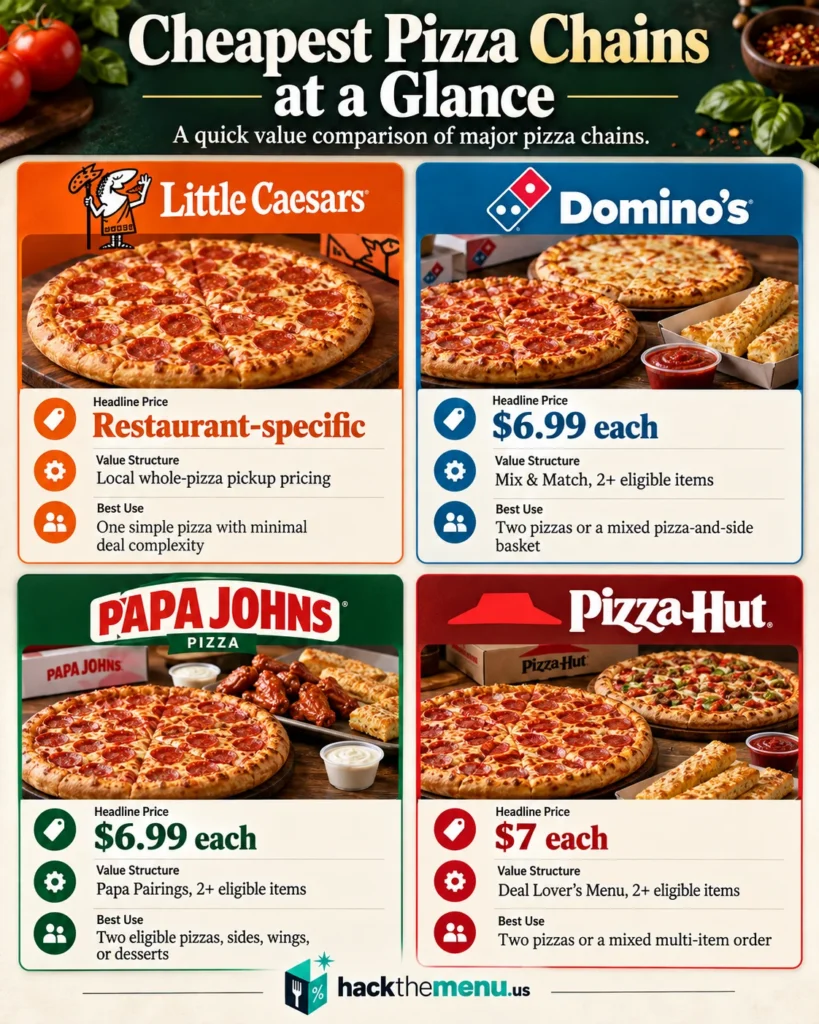
Cheapest Pizza Chains at a Glance
The most useful pizza-price comparison starts with deal structure rather than one regular-menu number. Domino’s and Papa Johns advertise the same $6.99 per-item starting point when at least two eligible items are ordered, while Pizza Hut’s comparable two-or-more structure begins one cent higher at $7. Little Caesars is harder to reduce to one national number because local restaurant pricing is central to its ordering flow.
| Chain | Value structure | Headline price | Best use |
|---|---|---|---|
| Little Caesars | Local whole-pizza pickup pricing | Restaurant-specific | One simple pizza with minimal deal complexity |
| Domino’s | Mix & Match, 2+ eligible items | $6.99 each | Two pizzas or a mixed pizza-and-side basket |
| Papa Johns | Papa Pairings, 2+ eligible items | $6.99 each | Two eligible pizzas, sides, wings, or desserts |
| Pizza Hut | Deal Lover’s Menu, 2+ eligible items | $7 each | Two pizzas or a mixed multi-item order |
A one-cent difference between Papa Johns and Pizza Hut is not enough to decide value by itself. Crust, size, topping count, sides, and what the group will actually eat matter more. The Domino’s vs Pizza Hut comparison and Domino’s vs Papa Johns comparison show how similar headline deals can produce different completed baskets.
When you want the two closest $7-style structures compared directly, see Pizza Hut vs Papa Johns. The correct winner is usually the chain w
hose eligible items match your order with the fewest paid upgrades.
Little Caesars: Best First Check for One Simple Carryout Pizza
Little Caesars is often the simplest place to start when the goal is one whole pizza for pickup. Its ordering flow is restaurant-specific, so the exact local price should be checked before comparing it with a national-style coupon from another chain. That makes it less useful for declaring one permanent U.S. sticker price but very useful for a direct nearby-store comparison.
The reserved Little Caesars menu is the natural restaurant-level reference for pizza sizes, crusts, sides, and local pricing. Its strongest value case is simplicity: one pizza, a small number of choices, and pickup without needing a two-item minimum.
Little Caesars can lose that simplicity advantage when the order adds several sides, specialty crusts, or delivery. At that point, a multi-item coupon from Domino’s, Pizza Hut, or Papa Johns can become more competitive even if the first pizza looked cheaper.
Domino’s: Strongest Published Carryout and Mix-and-Match Benchmarks
Domino’s is the easiest chain in this group to compare through repeatable national-style coupon structures. Its Mix & Match deal lists eligible items at $6.99 each when you choose two or more, while its carryout deal lists eligible one-topping pizzas at $7.99. Prices can be higher at some locations and selected crusts or toppings can cost extra.
The reserved Domino’s menu is the best place to compare pizza sizes, crusts, pasta, chicken, breads, and other items once that full menu is available on the site. For deal-level value, Domino’s becomes especially strong when two people want different pizzas or when the basket mixes pizza with another eligible item.
If the budget is broader than pizza alone, the best fast food meals under $10 article provides a useful benchmark for complete quick-service meals. Domino’s is harder to compare with burger combos because pizza is normally shared, so per-person value depends on how many slices each diner actually needs.
Pizza Hut: Best When the $7 Menu Fits the Whole Basket
Pizza Hut’s Deal Lover’s Menu prices two or more eligible favorites at $7 each. Eligible choices can include medium one-topping pizzas and other menu categories, so the format works best when the order needs more than one item. Pizza, pasta, wings, and other selections can carry additional charges depending on the restaurant and item.
The Pizza Hut menu gives the restaurant-level context for Personal Pan pizzas, medium and large pizzas, crusts, Melts, wings, pasta, sides, and larger boxes. Pizza Hut can beat a cheaper-looking pizza-only deal when its bundle or mixed-item structure replaces several things the group would otherwise buy separately.
A family should compare the number and size of pizzas first, then breads, wings, pasta, drinks, and desserts. Paying $7 for an item you did not want does not create value simply because it is part of a deal.
Papa Johns: Tied for the Lowest Two-or-More Headline Price
Papa Johns ties Domino’s at the $6.99 headline level for a two-or-more value structure. Papa Pairings can include eligible medium one-topping pizzas, bread sides, wings, and desserts, which makes it useful for mixed orders rather than pizza only. Prices and participation vary by restaurant.
The Papa Johns menu provides full size, crust, specialty pizza, wings, side, sandwich, and deal context. A $6.99 medium pizza can be a strong value, but the best comparison still matches the same pizza size and topping count across restaurants.
Papa Johns becomes more attractive when the group wants several eligible categories from the Pairings menu. If the order needs only one pizza, local store specials may matter more than the two-item headline price.
Which Pizza Chain Is Cheapest for Your Order?
The cheapest pizza chain changes when the order changes. One pickup pizza, two medium pizzas, a pizza-and-wings basket, and a family dinner all use different deal structures. Match the order purpose first, then compare the final local totals.
| Order goal | Best starting chain | Why | Main limitation |
|---|---|---|---|
| One simple pickup pizza | Little Caesars | Straightforward local whole-pizza comparison | No single national price settles every store |
| Two eligible deal items | Domino’s or Papa Johns | Both advertise $6.99 each with a two-item minimum | Upgrades and eligibility can change total |
| Two-item mixed menu basket | Pizza Hut | $7 Deal Lover’s menu spans several categories | Two-item minimum and some items cost extra |
| One carryout pizza coupon | Domino’s | $7.99 eligible one-topping carryout benchmark | Carryout only; crust/topping limits apply |
| Family pizza night | Compare all four locally | Pizza count, size, sides, and headcount matter most | Delivery and extras can erase deal savings |
For family orders, the cheapest pizza deals for feeding a family topic is the most specific value framework, while Fast Food Value Menus Compared helps explain how minimum-item requirements affect the real checkout total.
Pickup usually gives the cleanest pizza-price comparison because delivery can add fees and store-specific charges. The pickup vs delivery comparison explains why a low advertised pizza price can stop being the cheapest completed order after fulfillment costs are included.
For first-party offer details, use the official Domino’s coupons page and the official Papa Johns Papa Pairings page. Prices and participation vary by restaurant. Visit the Blog for more
restaurant price and value comparisons.

Frequently Asked Questions
What is the cheapest pizza chain in the USA?
There is no single cheapest chain at every restaurant. Little Caesars is a strong first check for one simple pickup pizza, while Domino’s and Papa Johns advertise very competitive two-or-more structures. Pizza Hut sits nearly level for multi-item deal orders.
Is Little Caesars cheaper than Domino’s?
Little Caesars can be cheaper for a straightforward local pickup pizza, while Domino’s can become cheaper when the order fits Mix & Match or its carryout deal. Compare the same size, crust, toppings, and service method.
Is Domino’s or Papa Johns cheaper?
Their headline two-item deal price is tied at $6.99 each for eligible items. The cheaper completed basket depends on which items qualify, crust upgrades, toppings, local pricing, and delivery charges.
Is Pizza Hut more expensive than Domino’s?
Pizza Hut’s two-or-more Deal Lover’s price is $7 per eligible item, while Domino’s Mix & Match starts at $6.99 each. That one-cent difference is too small to settle value because the eligible items and paid upgrades matter more.
Which pizza chain is cheapest for one pizza?
Little Caesars is the simplest first check for one local pickup pizza, while Domino’s has a clear $7.99 carryout benchmark for eligible one-topping pizzas. The exact winner depends on the selected restaurants and pizza format.
Which pizza chain is cheapest for two pizzas?
Domino’s and Papa Johns are strong starting points because both advertise $6.99-per-item two-or-more structures, while Pizza Hut’s comparable format starts at $7 each. Match pizza size and toppings before comparing.
How should I compare pizza prices near me?
Choose nearby restaurants, use the same pickup or delivery method, and match pizza size, crust, topping count, sides, and number of diners. Compare the completed local carts rather than one advertised number.