CASUAL DINING VALUE COMPARISON
Applebee’s vs Chili’s: Menu Prices Compared
Applebee’s and Chili’s compete across burgers, chicken, steaks, pasta, appetizers, and bundled meals, but their value formats are built differently. Prices vary by restaurant and ordering method, so the fairest comparison matches the same number of diners, similar portions, sides, and drinks before judging which costs less.
2 + 1
Applebee’s value format can pair two entrées with one appetizer.
3 parts
Chili’s value format can combine a drink, starter, and entrée.
Local prices
Restaurant and ordering channel can change the final total.
Broad menus
Both chains span burgers, chicken, steaks, pasta, and more.
Price note: Applebee’s and Chili’s can use location-specific pricing, restaurant-specific participation, and different totals for pickup or delivery. Compare the selected restaurants using the same ordering method before deciding which is cheaper.
Which Is Usually Cheaper, Applebee’s or Chili’s?
Neither chain is automatically cheaper for every order because the final bill depends on the restaurant, entrée, extras, and deal structure. Applebee’s menu value often becomes easier to see when two diners can use a shared appetizer-and-entrée format, while Chili’s menu has a strong single-diner bundled-meal structure. The useful comparison is the completed basket rather than the first entrée price.
For one person who wants a drink and starter with an entrée, Chili’s can have the cleaner bundle logic. For two people sharing an appetizer, Applebee’s can create a different kind of value. Browse the Casual Dining menus when you want more restaurant-style comparisons.
Applebee’s vs Chili’s Price Structure
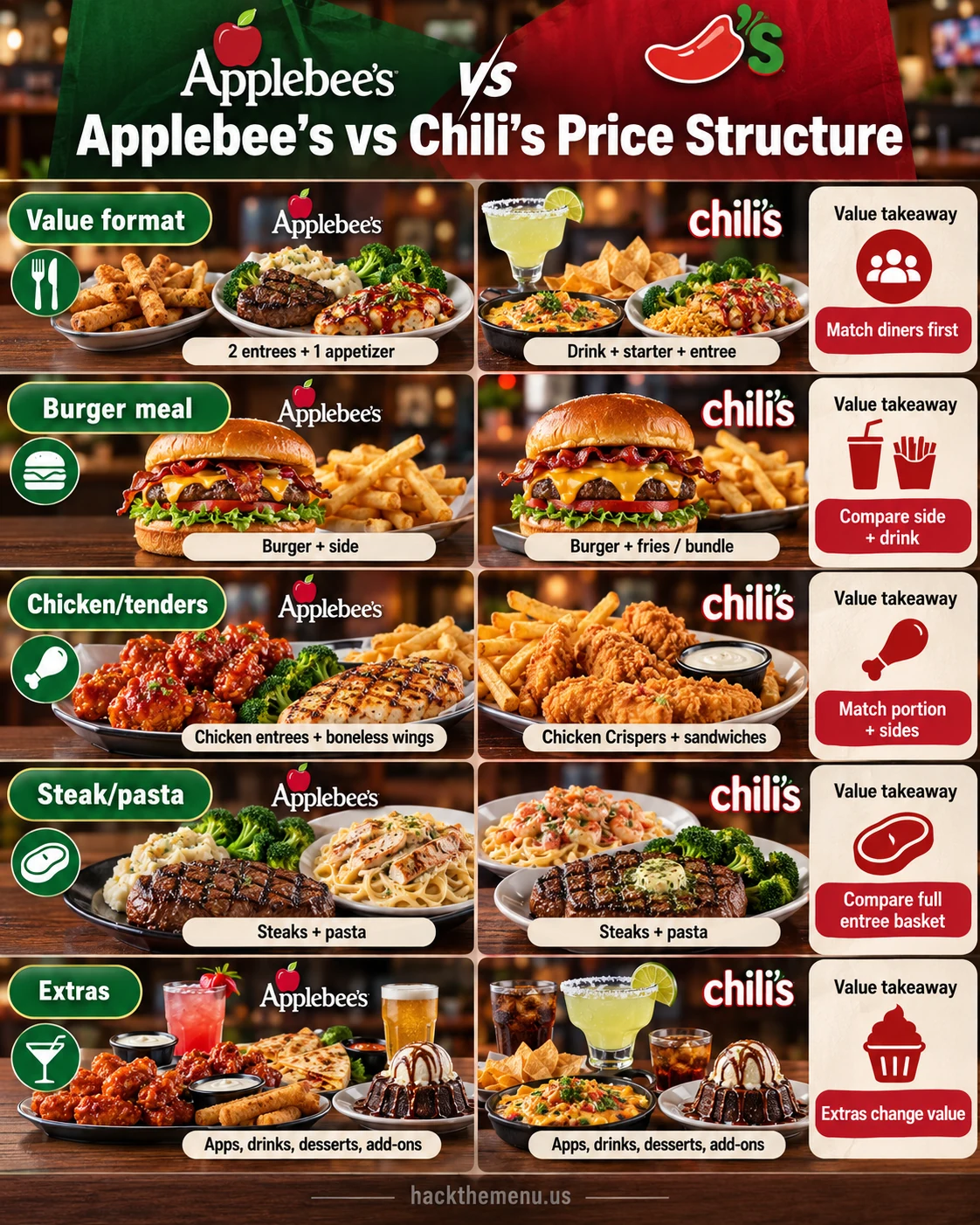
The chains use different bundle logic, so a direct entrée-to-entrée comparison can miss what is actually included. Applebee’s often frames shared value around two diners, while Chili’s has a well-defined single-diner bundle with multiple meal components. Use the table to compare the structure before looking at the final local cart.
| Comparison point | Applebee’s | Chili’s | Value takeaway |
|---|---|---|---|
| Value format | Two entrées plus one appetizer in qualifying deal structures | Drink, starter, and entrée in qualifying 3-part structures | Match number of diners first |
| Burger meal | Burger commonly paired with a side | Burger formats commonly include fries or fit bundled meals | Compare side and drink inclusion |
| Chicken/tenders | Chicken entrées and boneless-wing choices | Chicken Crispers and chicken sandwiches | Match portion and sides |
| Steak/pasta | Steaks and pasta across regular menu | Steaks and pasta across regular menu | Compare full entrée basket |
| Extras | Appetizers, drinks, desserts, paid add-ons | Appetizers, drinks, desserts, paid add-ons | Extras can erase a base-price advantage |
A bundled meal is only cheaper when you wanted the included components. If you would skip the appetizer or drink, à la carte may still cost less. The combo meal vs à la carte comparison explains why the finished basket matters more than the bundle label.
Which Restaurant Has the Broader Menu?
Both restaurants cover more categories than a typical fast-food chain. Applebee’s spans appetizers, bowls, steaks and ribs, burgers, chicken, pasta, seafood, sandwiches, salads, desserts, kids meals, and sides. Chili’s spans appetizers, fajitas, burgers, chicken, BBQ, pasta, steaks, bowls, quesadillas, salads, soups, kids meals, desserts, and party-style formats.
That breadth makes category matching important. Compare a burger with a burger, a steak with a steak, and a pasta entrée with another full pasta entrée before using price as the deciding factor. The portion size vs price comparison is useful when two entrées have different sides or serving sizes.
Meal Value for One, Two, or a Group
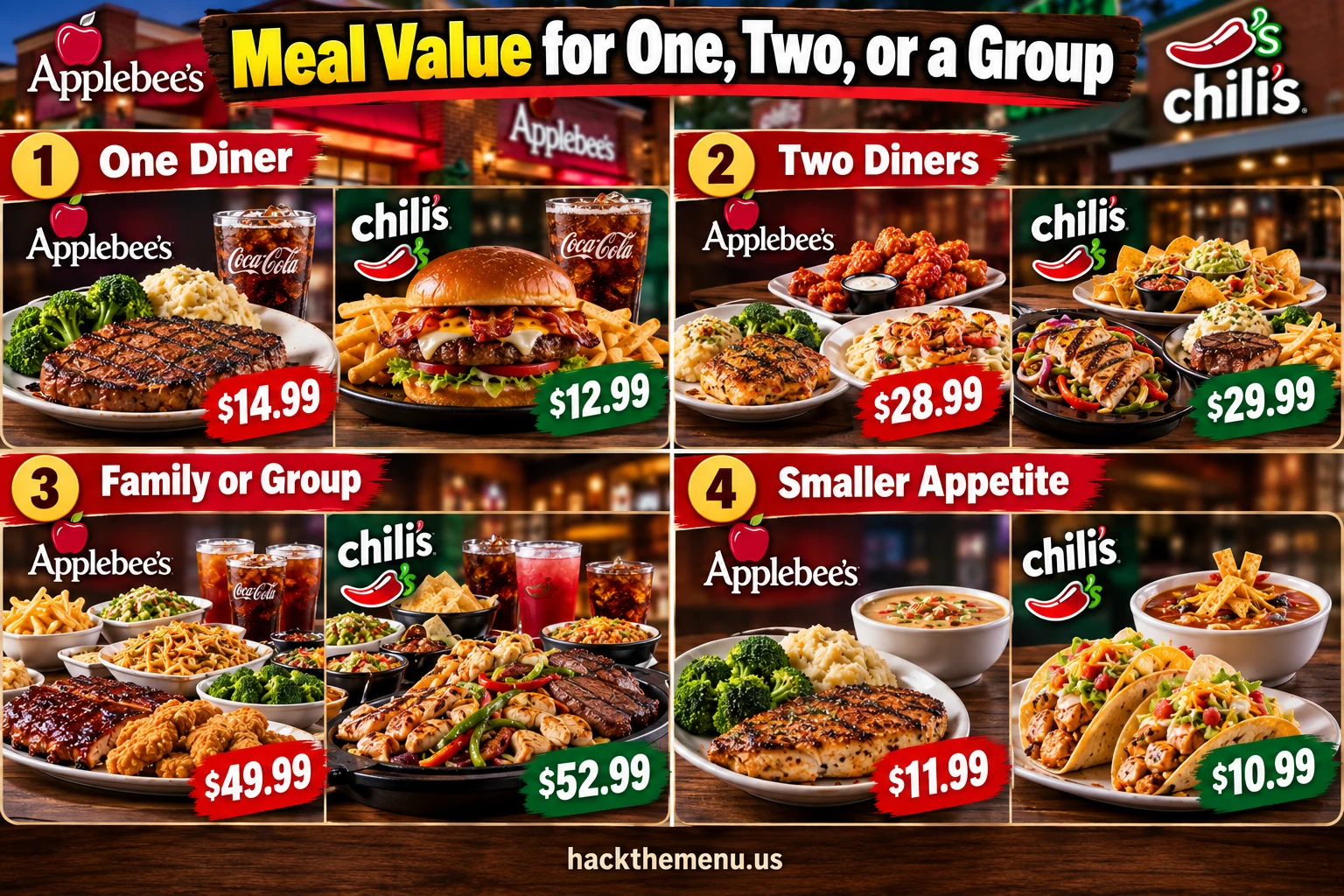
Value changes quickly with party size. Applebee’s shared deal format can fit two diners, while Chili’s three-part bundle is easier to evaluate as a single-person meal. Families should ignore those labels at first and build enough food for the same number of people.
| Order type | Applebee’s approach | Chili’s approach | Best comparison |
|---|---|---|---|
| One diner | One entrée plus desired side/drink | Single-diner bundle or à la carte entrée | Chili’s bundle logic can be easier to evaluate |
| Two diners | Shared appetizer plus two entrées can fit deal structures | Two individual bundles or shared appetizers plus entrées | Compare total food, not deal names |
| Family/group | Multiple entrées, appetizers, kids items, sides | Multiple entrées, kids items, sides, party options | Build the same group basket |
| Smaller appetite | À la carte entrée or lighter category | À la carte entrée, lunch-style or value format | Do not pay for unwanted components |
For groups, total basket cost and leftovers matter more than a low advertised starting point. The family meal vs individual meals analysis helps separate package value from true per-person value. For a broader budget benchmark, see restaurant meals for a family of four on a budget.
Customization, Secret Menus, and Add-Ons
Both chains allow customizations that can raise or lower the practical value of an order. Extra meat, premium sides, substitutions, sauces, appetizers, and desserts can move the cart far beyond the base entrée price. Removing ingredients does not always reduce the price, so review the final total after each change.
For modification ideas, visit the Applebee’s secret menu and Chili’s secret menu. Those pages focus on ordering variations rather than treating unofficial combinations as guaranteed named products.
Apps, Pickup, Delivery, and Deals
Ordering channel can change which restaurant looks cheaper. App pricing, restaurant-specific offers, delivery menu pricing, fees, taxes, and tips can all affect the completed total. The restaurant app vs in-store price comparison explains why identical food can produce different checkout amounts.
Use pickup on both sides when you want the cleanest food-price comparison. If you are choosing delivery, compare both through the same type of channel and include fees. See the pickup vs delivery comparison for the cost differences that sit outside the menu itself.
Deal-focused readers can also compare the Applebee’s happy hour and Chili’s happy hour pages. Participation and available offers vary by restaurant.
Applebee’s or Chili’s: Which Should You Choose?
Choose Applebee’s when your order fits a two-person shared-value structure, you want broad casual-dining choices, or you prefer building around a shared appetizer. Choose Chili’s when a single-diner bundled meal lines up with what you already want, especially when a drink and starter would otherwise be separate purchases. Neither advantage guarantees the lower checkout total.
The best comparison uses the same number of diners, similar entrée types, equivalent sides, the same drink assumptions, and the same fulfillment method. Restaurant pricing itself also varies by market and location, which is explained in how restaurant menu pricing works. Visit the Blog for more restaurant price and value comparisons.
For first-party menu details, use the official Applebee’s menu and the official Chili’s menu. Prices, participation, and availability vary by restaurant.
Frequently Asked Questions
Is Applebee’s cheaper than Chili’s?
Not for every order. Applebee’s can be compelling for two diners using a shared deal structure, while Chili’s can be easier to budget for one diner using a bundled meal. Compare the same local basket before choosing.
Which restaurant has better value for one person?
Chili’s often has the clearer single-diner bundle because a qualifying format can combine a drink, starter, and entrée. Applebee’s can still be cheaper for a specific entrée or local offer, so the restaurant-specific cart remains the deciding factor.
Which is better for two people?
Applebee’s shared two-entrée plus appetizer structure can fit two diners naturally. Chili’s can also work well when each person chooses an individual bundle or when the table shares appetizers. Compare total food and drinks rather than the promotion name.
Do Applebee’s and Chili’s prices vary by location?
Yes. Restaurant, market, franchise decisions, participation, and ordering channel can change the final total. Use the selected restaurant when exact price matters.
Which has more menu variety?
Both have broad casual-dining menus. Applebee’s covers burgers, ribs, steaks, chicken, pasta, seafood, bowls, salads, and more, while Chili’s covers burgers, fajitas, chicken, BBQ, steaks, pasta, bowls, quesadillas, salads, and other categories.
Which is better for pickup or delivery?
Pickup gives the cleaner menu-price comparison because delivery can add fees, tips, and channel-specific pricing. If delivery is the goal, compare equivalent baskets through the same type of ordering channel.
Should I compare deal prices or regular menu prices?
Use regular menu prices as the baseline, then measure the deal against the order you would actually buy. A promotion only saves money when its included items match your intended meal and do not encourage unnecessary extras.